Solanum melongena var. esculentum. Start seed early indoors, mid- to late March, for transplanting outside 8 - 10 weeks later. Space plants 2 - 3 feet apart in rows 2 - 3 feet apart. Eggplants need full sun and loose, deep, rich soil.
USDA Germination Standard: 60%.
—Eggplant Black Beauty. (250) VEGG-BB. Packet: $2.00
Ounce: $6.00
Classic large oval purple-black eggplants on big, spreading plants. Fine quality and keeps well.
—Eggplant White Egg. (50) VEGG-WE. Packet: $2.50
Pure white 2 - 3" oval fruit with mild flavor. Heavy yields, does well in short-season areas if started early.
ESCAROLE: See Specialty Vegetables
FENNEL: See Specialty Vegetables
GARLIC CHIVES: See Specialty Vegetables
GROUND CHERRY: See Specialty Vegetables
KALE
Brassica oleracea. Also known as Borecole, Kale is a cool weather crop, with sweet tender leaves. A good fodder plant for poultry and livestock. In the South, sow in late summer or early fall for winter and spring harvest. In cold climates, sow in late spring for fall harvest. Likes full sun and a rich, well-drained soil. Keep moist. Sow seeds 1/4" deep, thin to 1 1/2 feet apart in rows 1 1/2 - 2 feet apart.
USDA Germination Standard: 75%.
—Kale Black Lake. (1000) VKAL-BL. Packet: $2.00
Ounce: $5.00
1/4 Pound: $12.00
Long, narrow, deeply savoyed and curled leaves, dark green above, nearly black beneath. A Tuscan type, tender and flavorful. Good for baby salad greens, mature leaves great baked for chips.
—Kale Dazzling Blue. (250) VKAL-DZ. Packet: $2.50
Ounce: $9.00
1/4 Pound: $20.00
Striking lacinato type introduced by Wild Garden in 2016. Classic savoyed narrow leaves are bright blue-green with pink midribs. Tender and flavorful, hardier than other lacinatos.
—Kale Ethiopian. (200) VKAL-ETH. Packet: $2.50
Ounce: $9.00
1/4 pound: $20.00
Brassica carinata. The light green leaves have a delicious mild flavor, perfect as baby salad greens, or use mature leaves for cooked greens in soups and stews. Originally from Ethiopia, does well in mild climates but also tolerates both hot and cold weather. Also called Abyssinian Mustard or African Kale. The seeds are a good source for oil.
—Kale Lacinato. (1500) VKAL-LA. Packet: $2.00
Ounce: $5.00
1/4 Pound: $12.00
Classic Italian heirloom from Tuscany, with long narrow savoyed dark green leaves. One of the tenderest kales, with mild flavor. Very hardy, tastes even better after frost.
—Kale Lacinato Rainbow. (250) VKAL-LR. Packet: $2.50 OTC ORGANIC
1/4 Ounce: $8.00
Click for photo »
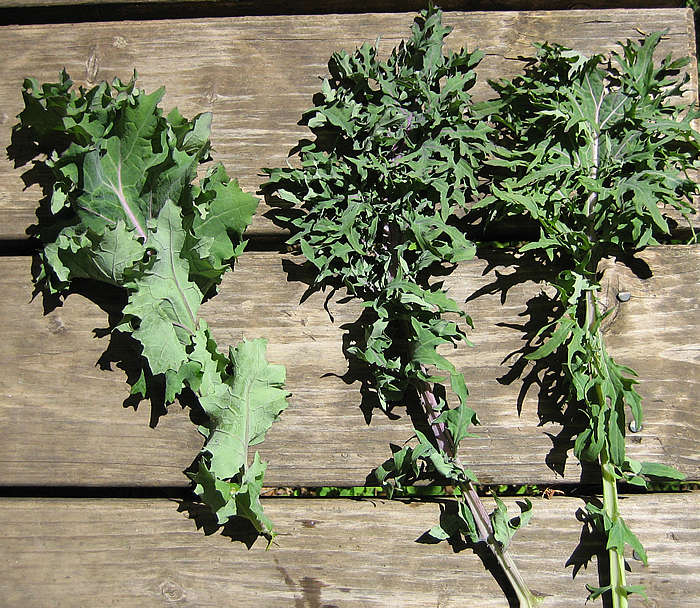
Deeply savoyed long narrow leaves overlaid with shades of purple, blue-green, and red. A variety of leaf shapes varying from nearly entire, to very frilly and divided. Very vigorous and cold hardy, perennial in mild climates. Organically grown.
—Kale Portuguese. (400) VKAL-PT. Packet: $2.50
Ounce: $9.00
1/4 pound: $20.00
One of the finest kales - tender, sweet, rich-flavored. Large loose heads of big rounded blue-green leaves with white veins. Well-loved in Portugal, where it is combined with potatoes and smoky sausage to make the traditional Caldo Verde. Great in salads and smoothies. Unlike most kales, this one is not frost tolerant, prefers a mild climate. Also called Couve Tronchuda and Tronchuda Beira.
—Kale Red Ursa. (250) VKAL-RU. Packet: $2.50 OTC ORGANIC
Ounce: $12.00
Outstanding variety with broad, slightly frilled leaves with red veins and purple stems. Great for salad mixes. Bolting stems from over-wintered plants are sweet and tender—eat like asparagus. Organically grown seed.
—Kale Russian Red. (1000) VKAL-RR. Packet: $2.00
Ounce: $6.00
1/4 Pound: $15.00
Outstanding variety with deeply ruffled leaves with purple veins. The whole plant may turn purple in cold weather. Tender and tasty. Grows year-round in mild climates, and may reach 4 feet tall.
—Kale White Russian. (50) VKAL-W. Packet: $2.50 OTC ORGANIC
1/4 Ounce: $7.50
Deeply ruffled dusky green leaves with white veins and mid-ribs. Stands wet soil, vigorous and productive. Nice in salads and braising mixes. In 1995 Garden City Seeds in Montana judged this to be the most cold-hardy and best tasting kale. Organically grown seed.
—Kale Wild Garden Mix. (100) VKAL-WGX. Packet: $2.50 ORGANIC SEED
1/4 Ounce: $6.00
Ounce: $12.00
Another diverse gene pool from Wild Garden Seed, begun by crossing Siberian and Red Russian, it now produces a wide variety of leaf types colors, all developed for summer sowing, fall harvest, and overwintering in mild climates. All are sweet and tender, not as strong-tasting as European kales.
KOHLRABI
Brassica oleracea var. Caulo-rapa. A member of the cabbage family, the stem forms a ball-shaped bulb which is eaten. It is a delicious vegetable combining the best qualities of turnip and cabbage when cooked, and is mild, sweet and crisp eaten raw. Sow in early spring or late summer, spacing plants 6 - 8" apart in rows 1 1/2 feet apart. Prefers cool weather and light, rich soil. Best young and tender.
USDA Germination Standard: 75%.
—Kohlrabi Early Purple Vienna. (500) VKOH-EP. Packet: $1.50
Ounce: $5.00
1/4 Pound: $10.00
60 days. An old-fashioned, pre 1885 variety with purple skin and leaves. Flesh white and tender, sweet and mild flavor cooked or raw.
—Kohlrabi White Vienna. (500) VKOH-WV. Packet: $1.50
Ounce: $5.00
1/4 pound: $10.00
Forms pale green globes with mild flavor, tender and crisp. The darker green leaves are eaten like kale.
LEEKS
Allium ampeloprasum var. porrum. Leeks are a popular vegetable in Europe and the Mid-East, where their mild, sweet, onion-like flavor is valued in stews, pies, casseroles and soups. They are hardy plants and may be sown in spring for harvest during fall, winter, or through to the following spring. Sow seed in early spring in rows 1 foot apart, thinning to 4" apart in the row. When plants are nearly mature, draw soil around the stalks to blanch.
USDA Germination Standard: 60%.
—Leek Blue Solaise. (200) VLEE-BL. Packet: $2.50 ORGANIC
French heirloom from the 1800s, with large sweet-flavored stalks and blue-green leaves that turn vivid violet in cold weather. Extremely hardy, excellent in short-season areas, sown in early summer for winter harvest. Organic.
LETTUCE
Lactuca sativa. Sow in rows 1 foot apart as early as the ground can be worked, not covering the seed, as light is needed for germination. Thin to 8" apart as they develop. Or, plant in flats 1 month before planting out. Transplant carefully. Lettuce prefers cool to moderate temperatures, and is best sown in spring or early fall in a light, well-drained soil. Give shade in hot weather. For a continual crop, sow every few weeks, as long as desired.
There are four basic types of lettuce: Loose-Leaf, Butterhead, Crisphead, and Cos or Romaine. Within these types there are also: Winter Lettuces, which are more adapted to cold and will withstand ordinary winters with little care. Spring Lettuces head rapidly and are sown just after winter. Summer Lettuces are usually larger and do not run to seed as fast in hot weather.
USDA Germination Standard: 80%.
—Lettuce Amish Deer Tongue. (100) VLET-AM. Packet: $2.50
Ounce: $9.00
Unusual triangular green leaves in thick, loose heads. Hardy and productive. Very flavorful.
—Lettuce Annie Oaky. (150) VLET-ANN. Packet: $3.00 ORGANIC
Very pretty small oak-leaf type, glowing deep red ruffled outer leaves with green-gold hearts. Crisp, crunchy, compact, and petite. Another beauty from breeder Frank Morton. Organic.
NEW—Lettuce Bloodstone. (200) VLET-BL. Packet: $3.00 ORGANIC
Beautiful small heads of rounded leaves with deep red streaks on green. Not only tender and tasty, but highly ornamental. A Frank Morton gem. Organic.
—Lettuce Camo Oakheart. (200) VLET-CO. Packet: $2.50 ORGANIC
1/4 Ounce: $20.00
Beautiful mix of dense-heading small-leaf plants in rich colors of ruby, deep purple, green, and gold. Another beauty from Wild Garden. Organic.
—Lettuce Hyper Red Rumple Waved. (250) VLET-HY. Packet: $2.50 OTC ORGANIC
1/4 Ounce: $12.00
Vivid deep purple-red leaves, strongly savoyed, semi-cos, with nice tender crumpled hearts. Remarkable summer color, cold-hardy into autumn. One of the most dramatic red lettuces from Wild Garden selections. Organically grown.
—Lettuce Jack Ice. (200) VLET-JI. Packet: $2.50 ORGANIC
Unusual dark green crisp-leaf variety, with striking deeply-toothed edges. Open, upright heads, crunchy, juicy, and sweet. Nice hefty plants, resistant to downy mildew and tip burn. Organically-grown.
—Lettuce Jericho. (3000) VLET-JR. Packet: $2.00
Ounce: $7.50
1/4 Pound: $20.00
Romaine type from Israel, with crisp, tall, bright green heaves. Slow bolting, heat tolerant yet does well in cool weather.
—Lettuce Lava Lamp Romaine. (200) VLET-LLR. Packet: $2.50 ORGANIC
1/4 ounce: $20.00
Tall heads are colorful all the way to the hearts, brightly marbled and streaked with red, yellow, green, and white. Thick and crunchy, stays sweet and tasty even when near bolting. Another beauty from Frank Morton. Organically-grown.
—Lettuce Lolla Rosa Darkness. (2000) VLET-LRD. Packet: $2.00
Ounce: $6.00
Compact heads of deeply curled, frilled leaves, with an intense dark burgundy color. One of the darkest of this type. Slow bolting for a long harvest. Good color and texture for salad mixes.
—Lettuce Mayan Jaguar. (150) VLET-MJ. Packet: $3.00 OTC ORGANIC
Upright romaine type, with green ruffled leaves with dark red spots. Sweet, juicy, and crunchy, with rose-pink hearts. Another nice one from Frank Morton. Organically grown.
—Lettuce Oak Leaf. (1000) VLET-OL. Packet: $2.00
Ounce: $6.00
1/4 Pound: $12.00
Thick rosettes of deeply-lobed medium-green leaves that stay sweet and tender, with no bitterness. Very heat-resistant, for long-lasting harvest throughout summer. An old favorite, with good reason.
—Lettuce Really Red Deer Tongue. (200) VLET-RRD. Packet: $2.50 ORGANIC
Long pointed triangular leaves are a deep, dark burgundy-red with white mid-ribs. Gives dark red leaves for cutting, plus a tender, buttery heart. Yet another fantastic variety from Frank Morton, selected for color, heat tolerance, and vigor. Organically-grown.
—Lettuce Strawberry Oakheart. (100) VLET-STO: Packet: $4.00 ORGANIC
Beautiful small heads of tall, pointed leaves, deep red outside, strawberry-red and gold inside. Tender and not bitter, the bolting stems are crisp and delicious too. Yet another jewel from Frank Morton's breeding program. Organic.
—Lettuce Wild Garden Mix. (250) VLET-WX. Packet: $2.50 OTC ORGANIC
1/4 Ounce: $12.00
The most diverse lettuce mix ever! From the premier lettuce growers at Wild Garden Seeds, this mix contains every variety they have, plus unreleased works-in-progress. Loose leaf, butter, crisp head, romaine—red, purple, green, bronze, speckled—frilly, round, narrow, wide. Amazing diversity for your salads! Organically grown.
MAIZE: See Corn.
MANGEL WURZEL: See Specialty Vegetables
MELONS
Cucumis melo. A group of annual melons that includes the heavily scented netted varieties known as cantaloupes, as well as the smooth-skinned melons such as crenshaw, casaba and honeydew.
Muskmelons need full sun and soil rich in organic matter. Plenty of water gives the best results. Sow seed when the weather has warmed, in hills spaced 4 - 6 feet apart each way. Plant 5 - 8 seeds per hill, thinning to the 3 or 4 best plants. Best sown direct to the garden, as they dislike transplanting. Wet soil prevents germination.
USDA Germination Standard: 75%.
—Melon Banana. (100) VMEL-BA. Packet: $2.00
Ounce: $5.00
1/4 pound: $12.00
Oval melons with yellow skin and incredibly fragrant, sweet orange flesh. A favorite since 1885.
—Melon Collective Farm Woman. (50) VMEL-CF. Packet: $2.50
Ounce: $7.00
A Ukrainian heirloom, with round, smooth 10" melons. Dark rind turns orange-yellow when ripe. Extremely sweet creamy-white flesh. Keeps well.
—Melon Delicious 51. (50) VMEL-D. Packet: $1.50
Ounce: $4.00
1/4 Pound: $10.00
One of the best O.P. (open pollinated) home garden cantaloupes. Round, well-netted 4 - 5 pound melons with deep orange flesh. Sweet, juicy and high quality.
—Melon Eindor. (50) VMEL-EN. Packet: $2.50
Ounce: $5.00
1/4 pound: $10.00
Sweet juicy pale green flesh, highly fragrant. Mid-sized oval netted melons turn gold when ripe. Needs a long hot season.
—Melon Ha'Ogen. (100) VMEL-HAO. Packet: $2.50
Ounce: $5.00
1/4 pound: $12.00
Small aromatic golden melons with light green flesh with a sweet, spicy flavor. The origin is cloudy, said to be from Hungary, and made its way to Israel where grown on Kibbutz Ha'Ogen, hence the name. Known for the superb sweet flavor, now a favorite in many parts of the world.
NEW—Melon Japanese Tiger. (40) VMEL-JT. Packet: $3.00
1/4 ounce: $7.50
Small oval melons with pretty green and yellow tiger striped skin. Pale green flesh, crisp, sweet, and refreshing. Enjoyed in Japan as a dessert, or added to salads. Melons reach 10 - 12 ounces.
—Melon Minnesota Midget. (100) VMEL-MM. Packet: $2.00
Ounce: $6.00
1/4 Pound: $12.00
Softball-sized melons have deliciously sweet golden flesh. Extremely early, can even produce two crops. Developed by the University of Minnesota in 1948. Compact plants can be grown in containers. Good for northern areas or small gardens.
—Melon Piel de Sapo. (35) VMEL-PL. Packet $2.50
Ounce: $6.00
1/4 pound: $14.00
Small oval melons with rough green and yellow rind. Pale green flesh is fragrant, sweet, and crunchy. Originally from Spain, where it is a favorite for the sweet flavor. The name means 'Toad Skin', and sometimes called Christmas or Santa Claus melon because it can keep for months because of the thick rind.
—Melon Sakata's Sweet. (100) VMEL-SAK. Packet: $2.50
Ounce: $5.00 BULK OUT OF STOCK - packets are still available
1/4 pound: $12.00 BULK OUT OF STOCK - packets are still available
Small round melons with thin, edible, bright yellow skin and crisp, sweet, pale yellow flesh. Eaten whole, like an apple. Called 'conomon melons' this type has been popular in China, Japan, and Korea for centuries. One of the most flavorful sweet types, developed by Sakata's Seeds of Yokohama.
—Melon Vine Peach. (100) VMEL-VP. Packet: $2.50
Ounce: $6.00
1/4 Pound: $15.00
Cucurnis melo Chito group. Also called 'Mango Melon'. Peach-sized yellow-orange melons, said to taste like mango. Vigorous and productive sprawling vine, can be staked. Many prefer it cooked, in pies, preserves and pickles.
—Melon White Crenshaw. (100) VMEL-WC. Packet: $2.00
Ounce: $6.00
Large 8 - 10 pound melons with smooth skin and crisp, spicy, white to rose pink flesh. Stores well. Crenshaws are said to be one of the sweetest in the melon family, created by crossing Casabas with Persian melons.
"The law, in its majestic equality, forbids the rich as well as the poor to sleep under bridges, to beg in the streets, and to steal bread."—A. France.
MUSTARD
Brassica juncea var. integrifolia. Mustard leaves are excellent greens with a sharp pungent flavor. Boiled like spinach, they become tender and not at all bitter. Very good in soups, or as simple cooked greens served with a little melted butter.
Plant in late spring or early summer, or in frost-free climates, sow in fall and early winter. Prefers a rich soil and abundant moisture for fast growth, but will produce well in any soil. Thin to 6" apart in rows 18" apart. A cool weather crop.
USDA Germination Standard: 75%.
—Mustard Dragon Feathers Mix. (250) VMUS-DF. Packet: $2.50 ORGANIC
1/4 Ounce: $6.00 BULK OUT OF STOCK - packets are still available.
Beautiful mix of textures and forms—frilled, rounded, feathery, in shades of green, gold, and purple. Highly flavorful, great for salad mixes. Bred by Frank Morton at Wild Garden. Organic.
—Mustard Florida Broadleaf. (1000) VMUS-F. Packet: $1.50
Ounce: $5.00
1/4 Pound: $9.00
Fast growing, with wide, dark green leaves and creamy white midribs. Vigorous and heat tolerant, popular in the South.
—Mustard Mizuna Red Streaks. (1000) VMUS-MZR. Packet: $2.00
Ounce: $6.00
Airy, narrow, deeply-cut leaves, strikingly colored burgundy-red and bright green. Peppery-sweet taste, perfect for salads and baby leaf mixes. A pretty container plant paired with calendulas, snapdragons, and nasturtiums. Stands heat, slow bolting.
—Mustard Tatsoi Red. (500) VMUS-TR. Packet: $2.50
Ounce: $5.00
1/4 pound: $10.00
Pretty rosettes of rounded purple-red leaves, mildly pungent, tender and crisp. Pick young for salads or grow to maturity for stir-fry or soup.
—Mustard Tat-Soy Savoy. (500) VMUS-TS. Packet: $2.00
Ounce: $5.00
1/4 Pound: $10.00
Compact rosettes of small spoon-shaped dark green leaves. Amazingly tender and mild flavored. Good in salads or lightly cooked. Sow in late spring through fall. Leaves crumpled and savoyed.
—Mustard Tokyo Bekana. (500) VMUS-TYB. Packet: $2.00
Ounce: $5.00
1/4 Pound: $12.00
Large bright green ruffled leaves like a loose head of lettuce. Sweet flavor and crisp texture. Good in salads or sautéed with ginger and soy Sauce. Makes good microgreens.
—Mustard Vibrant Ultraviolet. (100) VMUS-VU. Packet: $2.50 ORGANIC
1/4 Ounce: $6.00
Extraordinary color in a mustard—in cold weather the lobed leaves turn a deep, dark violet with vivid magenta-pink veins and sterns. Color like no other! Mild flavor, perfect for winter salads. From Frank Morton of Wild Garden Seeds. Organic.
OKRA
Hibiscus esculentus. A member of the Hibiscus family, Okra is a lovely annual with large yellow flowers followed by softly downy, ridged pods. These pods are delicious in spicy stews and soups, and even older pods are very good sliced thin and fried in butter till golden brown. Young pods good raw. The ripe seeds have been roasted as a coffee substitute.
Sow when weather has warmed, in a rich, somewhat sandy soil. Space 1 - 2 feet apart.
USDA Germination Standard: 50%.
—Okra Clemson Spineless. (50) VOKR-CS. Packet: $2.00
Ounce: $5.00
1/4 Pound: $8.00
55 days. All-America Silver Medal winner. Bears a large crop of rich green, flavorful pods till frost. Easily grown, requiring little more than water.
—Okra Eagle Pass. (30) VOKR-EA. Packet: $3.00
Ounce: $9.00
If you don't care for the slimy texture of okra, this is the one to try! From the Eagle Pass area of Texas, it produces fat tender green pods, used for gumbo or sliced and fried. No matter how it's cooked, it's not slimy or stringy. To 5 feet tall, with pods produced all up the stems. Likes sun and heat.
—Okra Hill Country Red. (50) VOKR-HCR. Packet: $2.00
Ounce: $5.00
1/4 Pound: $10.00
Short fat bright green pods blushed and streaked with red. Large plants with red Stems to 6 feet. Flavorful heirloom from the Texas hill country, great for pickling. Best picked when small.
—Okra Jing Orange. (50) VOKR-JO. Packet: $2.00
Ounce: $6.00
1/4 Pound: $12.00
Click for photo »
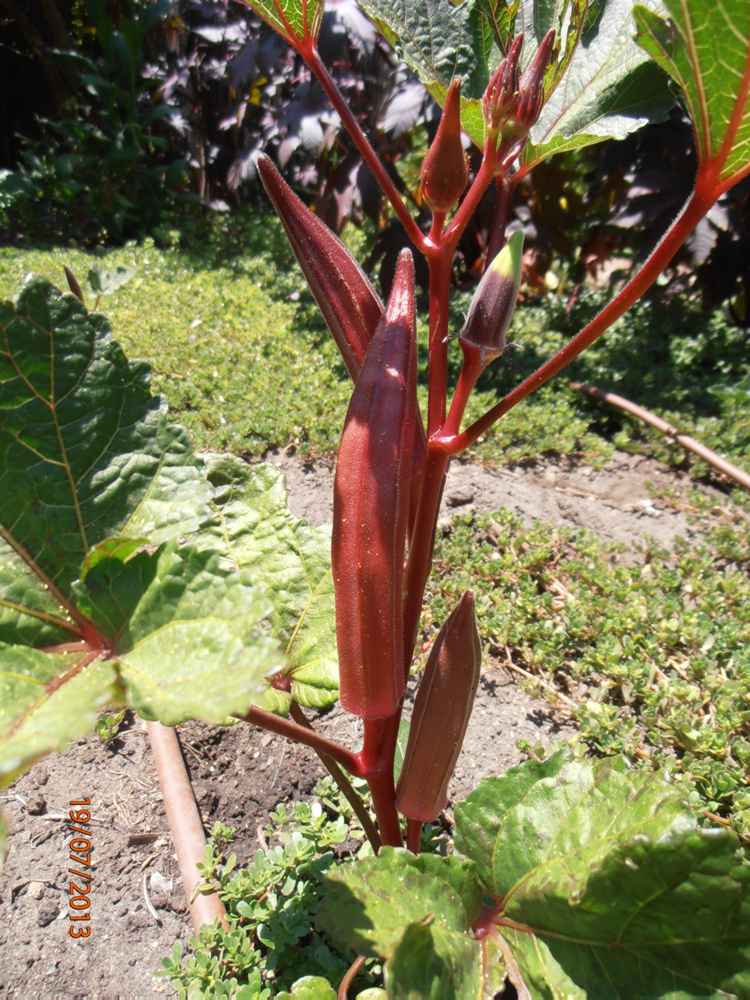
Thick meaty pods are a deep red-orange, making for very pretty plants. Highly productive and tolerates hot dry conditions.
—Okra Red Burgundy. (50) VOKR-RB. Packet: $2.00
Ounce: $5.00
1/4 Pound: $8.00
Beautiful 4 - 5 foot plants have deep wine-red pods and stems, green leaves, and large butter-yellow flowers. Tender 6 - 8" pods turn green when cooked. Nice enough for the flower-garden!
ONIONS
Allium cepa. Cultivated for thousands of years, onions are eaten worldwide. There are two main groups; those grown for the large yellow, red or white bulbs, and those grown for their slender green leaves, the 'scallions' of commerce, and generally known as 'bunching onions'.
Sow onion seed as early as soil can be worked, thinning to 4" apart for bulb onions, or 8" apart for bunching types. Light, loamy soil will produce the best crops. Onions like lots of compost or fertilizer. They can be harvested young, or left till the tops are dry, when they can be pulled up and stored in braids or with the stems broken off.
USDA Germination Standard: 70%.
NEW—Onion Crimson Forest. (500) VONI-CF. Packet: $2.00
Ounce: $8.00
Nice red-purple bunching type. Good in containers and small spaces.
—Onion Evergreen White Bunching. VONI-EW. Packet: $2.00
Ounce: $7.50
Allium fistulosum. A perennial bunching onion for green onions. Slender stalks of dark green leaves and white bases. Does not form bulbs, but divides to produce new shoots throughout the season. Very hardy, will grow over winter in most areas if given some protection from heavy freezing. Highly productive, first cutting in 3 months. Easy from seed.
—Onion Warrior Bunching. (750) VONI-W. Packet: $2.00
Ounce: $8.00
Fast and easy-to-grow bunching onion, with slender green and white stalks. Lasts longer in the garden than other bunching types. Excellent raw, grilled, or stir-fried.
PARSLEY
Petroselinum crispum. A favorite herb that adds flavor and vitamins to any dish. Use fresh or dried. Turnip parsley has large, edible roots which can be dug and stored through the winter.
Parsley seed is often slow to germinate. It likes a rich, moist soil, and will become perennial in mild climates. In cold winter climates, grow indoors or mulch heavily to protect from frost.
USDA Germination Standard: 60%.
Leaf Types:
—Parsley Common or Plain Leaf. (1000) VPAR-C. Packet: $1.50
Ounce: $5.00
1/4 Pound: $10.00
75 days. Also known as Italian Parsley, this type is the best for drying and for soups. It has flat, wide green leaves on a vigorous and spreading plant. Will form large clumps under favorable conditions. Stronger flavor than the curled leaf types, and retains more taste when dried.
—Parsley Forest Green. (500) VPAR-FG. Packet $1.50
Ounce: $5.00
1/4 Pound: $10.00
A moss curled variety to 1 foot, with finely-cut and well-curled leaves. Best flavor of the curled types. Takes hot dry conditions without fading. Adds flavor and texture to salad mixes.
PEAS
Pisum sativum. Peas are a cool weather crop, and like humidity. Sow early in spring in rows 1 foot apart for dwarf varieties, 3 feet for tall varieties. Plant seeds 1 - 2" deep. Thin to 4 - 6" apart. Stake tall varieties when about 6" high. For succession, sow at intervals of 1 - 2 weeks till midsummer. In the South, sow in fall for winter harvest. Peas are classed as smooth or wrinkle seeded. The smooth types are best for drying, freezing or canning, wrinkled types are sweeter and best for eating fresh. Edible podded peas, such as Snow Peas or Sugar Peas, have tender, sweet pods which are eaten when the peas inside are still very young and small.
USDA Germination Standard: 80%.
—Pea Cascadia Snap. (50) VPEA-CS. Packet: $2.00
1/4 pound: $5.00
Plump dark green 3" pods are crisp, sweet, and juicy. Short vines to 2 - 3 feet, good in containers. Whole pods eaten raw or lightly cooked. Bred by Jim Baggett at Oregon State University.
—Pea Dwarf Grey Sugar. (100) VPEA-DGS. Packet: $2.00
1/4 Pound: $5.00
Flat light-green 3" pods are great for stir-fry. Early and prolific bushy plants with purple flowers. The classic edible-pod pea, introduced in 1892.
—Pea Golden Sweet Edible Pod. (50) VPEA-GS. Packet: $3.00
1/4 Pound: $10.00
Bright lemon-yellow pods on 6 foot tall plants, with lovely two-toned purple flowers. Best when eaten small. Originally obtained from a market in India. Very nice.
—Pea Green Arrow. (50) VPEA-GA. Packet: $2.00 OUT OF STOCK
1/4 Pound: $5.00 BULK OUT OF STOCK
An amazingly productive English variety, with slender pods containing 8 - 11 small peas. Vines grow to 28" tall, usually setting double pods held at the top for easy picking. Peas are very sweet, great for eating fresh or lightly cooked.
—Pea Swenson Swedish. (50) VPEA-SW. Packet: $2.50
A fine snowpea brought to the U.S. from Sweden by Charles Swenson's family in 1876. Sturdy and productive vines bear sweet tender pods. In Sweden they are picked young, cut into small pieces and cooked in a cream sauce.
PEPPERS
Capsicum species. Peppers need a long warm season and very rich soil to produce large fruits. Sow seed indoors in early spring, transplant outside about mid May. Space 1 1/2 feet apart in rows 3 feet apart. Many peppers are perennial in mild winter areas. Both sweet and hot peppers turn red at maturity, but can be eaten either green or red. They contain high amounts of Vitamin C, particularly when red. The leaves are also edible and used in cooking. A popular crop.
USDA Germination Standard: 55%.
We have been getting more reports of peppers not being true to type, so please let us know if any of these are off-types.
Sweet or Mild Varieties:
—Pepper California Wonder 300 TMR. (300) VPEP-CW. Packet: $2.50
Ounce: $6.50
1/4 Pound: $18.00
Classic big blocky bell peppers, thick and crisp, with mild flavor. Good for stuffing, roasting, grilling, or fresh eating. Deep green to red.
—Pepper Diamond. (100) VPEP-DI. Packet: $2.50
1/4 ounce: $8.00
Ounce: $21.00
Unique sweet peppers are a luminous white, ripening to pale yellow. Thick and succulent, mild and crisp, great stuffed, fried, grilled, or fresh.
—Pepper Emerald Giant. (75) VPEP-EM. Packet: $2.00
1/4 ounce: $5.00
Ounce: $12.00
Big, thick, juicy bell peppers, sweet and crunchy. Dark green turning red when ripe. A classic stuffing pepper. Selected for disease resistance and high yields.
—Pepper Habanero Red Sweet. (40) VPEP-HRS. Packet: $3.00
1/4 Ounce: $12.00
These crinkled red habaneros have the smoky sweet flavor without the burn. The complex taste with no heat makes this a superb addition to many dishes, and makes great pickles.
—Pepper Habanero Yellow Sweet. (50) VPEP-HYS. Packet: $3.00
1/4 Ounce: $12.00
Wrinkled fruits like the classic yellow Habanero, but without the heat. Sweet, smoky flavor, delightful in salsas, soups, tamales, rice, etc. Good for drying and freezes well.
—Pepper Orange Sun. (50) VPEP-OS. Packet: $2.50
1/4 Ounce: $9.00
Ripens to a glowing orange, with a mild sweet flavor. Blocky thick crunchy peppers, perfect for roasting and grilling.
—Pepper Pasilla Bajio. (200) VPEP-PSB. Packet: $2.00
Ounce: $8.00
Long slender peppers, 7" long by 1" wide. Dark green ripening to chocolate brown. Mild and rich flavored, most often dried and toasted for use in mole anti other Méxican sauces. Fresh they are called chilaca. The word pasilla means 'little raisin', and several different chiles are called pasilla dried.
NEW—Pepper Poblano. (50) VPEP-POB. Packet: $2.50
1/4 Ounce: $6.00
Ounce: $14.00
Triangular 3 - 5" chiles with a mild, rich flavor, the classic pepper for chiles rellenos. Called poblano when fresh and dark green, and ancho when ripened to dark red and dried. When dried they are used in a number of delicious sauces, such as mole poblano.
Hot Varieties:
—Pepper Anaheim. (=Long Green Chili) (100) VPEP-A. Packet: $1.50
Ounce: $6.00
Tapered 6 - 8" light green peppers, changing to scarlet at maturity. Mildly hot, excellent for stuffing, canning or frying. An old favorite.
—Pepper Bhut Jolokia. (75) VPEP-BHJ: Packet $3.00
1/4 Ounce: $12.00
Capsicum chinense x C. frutescens. From Assam India, this ranks as one of the hottest peppers known to man, 3 times hotter than Habaneros. Fruits 2 - 3 inches long, tapering to a point. Slightly wrinkled, with notoriously thin skin, ripens orange to red. May be slow to germinate if not warm enough, doing best in hot, humid areas. Also called Ghost Pepper, in 2007 it was certified as the world's hottest chile, a title it held for a couple of years before losing it to the Trinidad Scorpion. Best to wear gloves when chopping these!
—Pepper Biquinho Yellow. VPEP-BQY. Packet: $3.00
1/4 ounce: $15.00
Capsicum chinense. Small semi-hot peppers from Brazil. The name means "little beak", as the fruits are round with a pointed tip like a bird's beak. This is the unusual yellow type. In Brazil these peppers are popular pickled in vinegar, but are good in any recipe, fresh or dried. Has the smoky, fruity flavor of Habaneros, but is only mildly hot.
—Pepper Cayenne Fiesta Blend. (75) VPEP-CAF: $2.50
1/4 Ounce: $8.00
Classic cayenne pepper in a glorious blend of colors—orange, yellow, green, purple, and red. Slender 3" tapered fruits, moderately hot, great fresh or dried. Colors stay bright when dried, good for striking fall decorations.
—Pepper Fish. (25) VPEP-FS. Packet: $2.50
5 grams: $15.00
Striking African-American heirloom, with white and green striped foliage on spreading plants to 2 feet tall. Hanging fruits are green with cream stripes, ripening through orange with brown stripes, and finally to all red. Medium hot, used for shellfish cooking around Chesapeake Bay. Makes great salsa, and the plants are very ornamental.
—Pepper Habanero Chocolate. (40) VPEP-HC. Packet: $3.00
1/4 Ounce: $12.00
Beautiful deep mahogany-red peppers in the classic Habanero shape and heat.
—Pepper Hawaiian Bird. (20) VPEP-HB: Packet $3.00
Small slender peppers about 1 inch long, tapering to a rounded point, ripens from green to red. Slightly sweet and tasty, and packing terrific heat! Peppers grow upright on big bushy plants, vigorous and easy to grow in mild climates. Tender perennial shrub to 5 feet. Naturalized in Hawaii, spread by birds who eat the fruit eagerly, amazing the watching humans. In Hawaii, they are made into the popular local condiment "chili pepper water", a blend of vinegar, water, fresh chiles, garlic and salt.
—Pepper Lemon Drop. (50) VPEP-LM. Packet: $3.00
Click for photo »

Beautiful clear yellow 2 - 3" long peppers, thin and slightly wrinkled. Very hot, and some detect a citrus flavor. Peru. Makes bright yellow powder.
—Pepper Mulato Isleno. (100) VPEP-MI. Packet: $2.50
1/4 Ounce: $6.00
Ounce: $15.00
Wide-shouldered tapering peppers, 6 inches long. Mildly spicy, ripens to red-brown. A favorite for chiles rellenos, mole, salsa or for drying.
—Pepper Padron. (75) VPEP-PD. Packet: $2.50
1/4 ounce: $6.00
Famous small peppers from northern Spain. They start out mild when young, and turn very hot when red. Plants are 4 feet high and 3 feet wide, giving 50 - 100 peppers per plant. Does well in the North.
—Pepper Satan's Kiss. (50) VPEP-SK. Packet: $2.50
Click for photo »

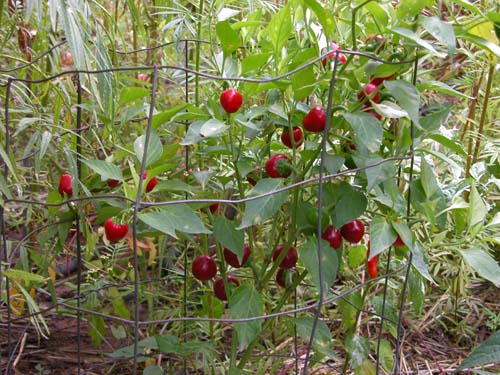
Small round cherry pepper with a good amount of heat, though said to lose about half its heat when cooked. Also called Baccio di Satana, Ciliegia Picante, and Picante Calabrese.
NEW—Pepper Tabasco. (50) VPEP-TA. Packet: $3.00
1/4 Ounce: $12.00
Small, slender, upright peppers cover the bushy 4 foot tall plants. Ripens from green to yellow to red, with a spicy flavor. Said to have been introduced into Louisiana in 1848 from the Mexican state of Tabasco, and after the Civil War became the sauce made famous by the McIlhenny family on Avery Island.
—Pepper Xigole. (25) VPEP-XI. Packet: $2.50
Gram: $7.50
5 grams: $15.00
Very small hot peppers grow up-turned and are bright red when mature. A long-lived perennial in the cool Oaxacan mountains, but needs more warmth than Manzano to really thrive. Extremely hot. Name pronounced 'she-GO-lay'. Also called 'Soltero' (bachelor), a humorous allusion to the shape and upright habit of the fruits. "I grew this for several years and it provided all my hot pepper needs with plenty to give away. I liked it because I could carry over a plant or two in a sunny window. It carried on until Christmas and started blooming again as soon as I moved them outside for the summer. They bore like this for 2 - 3 years. Also it was the hottest pepper I've ever grown, including Habanero and Serrano."—B. T., North Carolina,1/98.
PUMPKINS
Large vines whose fruits, small or large, are delicious, and are made into pies, stuffed, baked like winter squash, or pureed for soup. Carved and decorated, they play an important role in our yearly Halloween celebrations. The seeds are rich in oil and protein, and are excellent eaten whole, after roasting in salt and oil.
Plant seeds in rich, well-manured soil when all danger of frost is past and ground has warmed, in hills 6 feet apart. Place 5 - 10 seeds per hill, and cover lightly with soil. Thin to 3 or 4 of the strongest plants in each hill. They are vigorous and rampant growers that like abundant moisture, and need plenty of room to spread. Wet soil prevents germination.
USDA Germination Standard: 75%.
—Pumpkin Casper. (15) VPUM-CA. Packet: $2.50
Ounce: $6.00
1/4 Pound: $18.00
Cucurbita maxima. Luminous white, medium-sized pumpkins with very sweet dark orange flesh. White pumpkins generally have a higher sugar content, better for pies. The smooth white skin is great for painting Jack-O-Lanterns. Great for both eating and decoration.
—Pumpkin Cherokee Bush. (25) VPUM-CH. Packet: $2.00
Ounce: $9.00
1/4 pound: $22.00
The perfect pumpkin for small gardens or limited space. Compact bushes produce round 5 - 8 pound pumpkins that are a deep Halloween-orange with yellow flesh. Great for Jack 'O Lanterns, and makes delicious pies, breads, and soup.
—Pumpkin Mammoth Gold. (20) VPUM-MG. Packet: $1.50
Ounce: $4.00
1/4 Pound: $9.00
Cucurbita maxima. For giant pumpkins, try these—40 - 60 pounders are common, and with careful pruning and fertilizing you can get 100 pound pumpkins. Lovely smooth golden-orange skin, orange flesh.
—Pumpkin Miniature Blend O.P. (75) VPUM-MN. Packet: $2.50
Ounce: $9.00
1/4 pound: $15.00
Beautiful mix of small pumpkins in various shapes and colors—round, flat, smooth, and ribbed, in white orange, green, and speckled. Delicious for eating as well as striking ornamentals.
—Pumpkin Rouge Vif d'Etampes. (10) VPUM-R. Packet: $2.50
Ounce: $7.50
1/4 Pound: $18.00
Cucurbita maxima. An Heirloom French variety, with striking shiny bright red-orange skin. Round, flat shape with deep ribs and indented stem, thick yellow-orange flesh. To 15 - 20 pounds. Mild flavor, keeps well if carefully cured. The glowing red color and unusual shape are very appealing.
—Pumpkin Sugar Pie. (=Small Sugar) (25) VPUM-SP. Packet: $1.50
Ounce: $4.00
1/4 Pound: $7.00
Cucurbita pepo. Long-time favorite for eating. Small, orange, slightly flattened 6 - 8" pumpkins, with thick, sweet, orange-yellow flesh. Keeps well, one of the best tasting and widely adapted.
—Pumpkin Ugly Duckling. (15) VPUM-UD. Packet: $3.00
Ounce: $9.00
This French heirloom resembles the classic Cinderella pumpkin, but in colors from pale gold to deep orange-red, some with green stripes and rough skin. Large flattened pumpkins with thick smooth flesh. Excellent ornamental and for cooking, nothing ugly about it!
—Pumpkin Winter Luxury. (35) VPUM-WL. Packet: $2.50
Ounce: $6.00 BULK OUT OF STOCK - packets are still available
1/4 Pound: $18.00 BULK OUT OF STOCK- packets are still available
Cucurbita pepo. Small orange pumpkins, perfectly round, with elegant pale netting. Very sweet velvety-smooth flesh makes this one of the finest pie pumpkins. Introduced in 1893, this beauty has been a favorite for over a century.
—Pumpkin Yellow of Paris. (20) VPUM-YP. Packet: $2.00
Ounce: $6.00
1/4 Pound: $18.00
Cucurbita maxima. Huge French heirloom pumpkin, usually about 25 pounds, but can reach over 100 pounds. Dusky orange skin, sweet yellow flesh. Slightly ribbed and flattened. Superb flavor, popular in France for baking or soups. Stores well.
PURPLE GOOSEFOOT : See Specialty Vegetables
QUINOA: See Specialty Vegetables
RADISH
Raphanus sativus. Crisp roots with a hot spicy flavor, radishes are one of the easiest vegetables to grow. The sprouted seeds can be added to salads or sandwiches for a wonderful, mildly hot flavor.
Sow seed as early as ground can be worked in spring, and successively till mid-summer, and again in early fall. Oriental radishes may be sown at any time as they do not have the tendency to become pithy in hot weather like other radishes. Plant 1/2 - 1" deep in any good soil. Space rows 1 foot apart; thin to 2" apart as soon as seedlings appear. Keep soil moist for best results.
USDA Germination Standard: 75%.
—Radish China Rose. (100) VRAD-CR. Packet $1.50
Ounce: $5.00
1/4 Pound: $8.00
Rose-pink oblong 6" roots, wider at the tip. Crisp and a good keeper. A Chinese winter variety, for spring or fall sowing. Said to have been brought to Europe from China by Jesuit missionaries. Pre-1850.
"The China Rose radishes are really interesting—they take much longer to reach the eating stage, but the plants grow much bigger, the bulbs are much bigger, and don't seem to get woody when so big, and a good keeper."—Eugenie Fellows, Florida, 1/96.
—Radish German Giant. (=Parat) (500) VRAD-GG. Packet: $2.00
Ounce: $5.00
Huge round radishes from Germany, can reach baseball size but never spongy. Cherry red outside, pure white inside, mild flavor.
—Radish Halloween Mixed. (300) VRAD-HAL. Packet: $1.50
Ounce: $5.00
1/4 Pound: $10.00
Very pretty and tasty small round radishes in purple, white, yellow, and black. Colorful bunches for farmer's market sales.
—Radish Helios. (500) VRAD-HE. Packet: $2.00
Ounce: $5.00
1/4 Pound: $9.00
Unique radishes with pale yellow skin and white flesh and good flavor. The unusual color is outstanding for farmer's market sales.
—Radish Jelly Bean. (200) VRAD-JB. Packet: $2.00
Ounce: $5.00
1/4 Pound: $9.00
Special colorful blend of old-fashioned open-pollinated varieties. Includes whites, reds, purples, and pinks, round or oblong, small and large.
—Radish Pink Beauty. (500) VRAD-PB. Packet: $1.50
Ounce: $5.00
1/4 Pound: $9.00
Beautiful round bright pink radishes with crisp white flesh that resists pithiness. Good flavor, a great variety for farmer's markets.
—Radish Purple Plum. (100) VRAD-PP. Packet: $1.50
Ounce: $5.00
1/4 Pound: $9.00
Round purple roots, white interior. Crisp, mild, resists pithiness. Unusual color for market gardens.
—Radish Round Black Spanish. (100) VRAD-RB. Packet: $1.50
Ounce: $5.00
1/4 Pound: $10.00
60 days. Large, round 3 - 4" roots with pure black skin and firm, juicy white flesh. Strong flavored, hardy, stores well. Pre 1885 variety. My favorite.
—Radish Sango. (400) VRAD-SAN. Packet: $2.00
Ounce: $5.00
1/4 pound: $10.00
Developed for microgreens, it produces crisp purple and green sprouts. Nice radish heat and flavor. Great added to salads or sandwiches.
—Radish Watermelon. (100) VRAD-WA. Packet: $2.00
Ounce: $6.00
1/4 Pound: $10.00
Large round white radishes blushed green outside, deep magenta-red inside. Slices look just like slices of a mini-watermelon! Crisp, spicy flavor, best picked at 1 - 2", though they can reach tennis-ball size. Our favorite radish.
—Radish White Tipped Scarlet Turnip Radish. (=Sparkler) (500) VRAD-WTS. Packet: $1.50
Ounce: $5.00
1/4 Pound: $10.00
(=Sparkler White Tip) A very early, handsome French radish grown in Europe since the 1880's. Roots are round, slightly flattened, a lovely deep rose-crimson above, with pure white tips. The pleasing color contrast and earliness made this the favored variety of Parisian market gardeners at the turn of the century.