J. L. HUDSON,
SEEDSMAN,
BOX 337,
LA
HONDA,
CALIFORNIA 94020-0337
USA
2013 SEEDLIST - Reserved Access List
How to Request Seeds
Request Form for requests sent by
the postal service.
Online Requests for e-mail
requests with PayPal payment only.
Don't forget postage and
packing!
Packet Size and Potential
Germination
Bulk Seed
Reserved Access
Only the seeds on this page are limited-access—not to
restrict availability, but to encourage successful propagation. (About
Reserved Access) All other seeds are unrestricted access.
To receive these seeds, simply write on your request "I agree to the
reserved-access terms."
NOTE: We do not supply these seeds unless you include the
sentence: "I agree to the reserved-access terms." on your request!
Two types are reserved-access: rare, threatened, or endangered species, and
seeds with prolonged, irregular, uncertain, or exacting germination
requirements. To insure they reach experienced, qualified propagators, and to
weed out "consumer-types", we reserve access to these seeds to those
who:
1. Agree to propagate and distribute the plants, and to share their germination
results.
2. Agree to distribute solely in the public domain—no patents, trademarks, or
other intellectual property.
3. Commercial propagation is encouraged, but in the unlikely event that
large-scale commercial distribution is achieved, benefit-sharing along the path
towards the source, in accordance with the spirit of the International
Convention on Biological Diversity, will be undertaken.
4. Absolutely, positively, NO refunds or replacements for any reason other than
out-of-stock!
Thanks for helping insure that we can continue to distribute these special
seeds!
ACACIA
—Acacia simplicifolia (=simplex) (10,h) R-ACAC-117. Packet:
$5.00
25 seed: $10.00, 100 seed: $30.00, 1000 seed: $225.00
Extremely rare tree or shrub to 40 feet, with broad, oval, pointed 2 - 4"
leaves, and small flower-balls followed by 6" pods. Endemic to New
Caledonia and Vanuatu, often growing in seashore dunes. Does well in Florida—try
it in S. California and Texas. "This tree thrives on abuse. It seems to
grow with no water, highly alkaline soil, and strong sunlight. It is remarkable.
My trees were submerged in salt water during a storm and did not even
blink."—H.P., Florida Keys. Nick seed to germinate in 2 - 4 weeks.
Scarce as hen's teeth!
To maximize germination of these
expensive seed: Nick seed lightly with a file - just abrade the surface and
don't go all the way to the quick - then soak for 15 minutes in a solution
made of 1 part household bleach and 8 parts water. Rinse them well. Fold a paper
towel into quarters and moisten with distilled water. Squeeze out excess, so it
is just damp, and put on a clean plate. Put the seeds (nicked side down) on the
towel and cover with plastic wrap, leaving an air space above the seeds. Keep in
a warm place (70 - 80°F) and inspect every day. Any seeds that don't swell in
a day or two should be re-nicked and re-sterilized. Any seeds that develop mold
should be removed and re-sterilized and put on a separate plate - most of
these will sprout, too, but this keeps the others clean. When the roots are a
half-inch long, plant the seed in a light, well-drained seed-starting mix, and
keep warm. If you have had trouble with these in the past, try this method and
you are sure to be successful! This method gives high germination.
ALLIUM
—Allium
karataviense. (e,v) R-ALUM-45. Packet: $2.50
'BLUE TONGUE LEEK'. White-lilac starry flowers in giant round balls up to 8
- 12" across. Ornamental grey-green 4" wide leaves mottled purple.
Central Asia. Zone 5. Very hardy. Give outdoor cold treatment and hold pots several
years for complete germination, as varying temperatures help.
ASPERULA (as-PER-oo-la or as-per-OO-la)
RUBIACEAE. 'WOODRUFF'. Herbs with whorled leaves and small flowers, grown in
the border and rockery for their abundant bloom and for herbal use. Best in part
shade and moist soil. Sow seeds in April for summer bloom, and September for
early spring bloom. Seed viable over 3 years.
—Asperula odorata. (=Galium odoratum) (c,v) R-ASPR-12. Packet: $3.00 OUT OF STOCK
'SWEET WOODRUFF'. Sprawling perennial to 6 - 8", with whorled leaves
and white flowers in clusters in May. Eurasia. Zone 3. Useful ground cover for shady
places under trees, as it spreads rapidly and smothers itself with bloom. The
herbage is not scented when fresh, but on drying it becomes perfumed with a
delightful scent which is retained for years. The fresh shoots are steeped in
wine and beer, including the famous 'May Wine' drunk on May first in Germany.
They are also added to tobacco and snuff, and are placed among clothing. Germination prolonged, 7 months or more, and hold pots over 2 - 3 years for
stragglers.
CARDIOCRINUM (kar-dee-o-KRI-hum)
LILIACEAE. Giant Himalayan lilies, grown for their striking display.
—Cardiocrinum cordatum. (d,v) R-CARDI-8.
Packet: $3.00
Click for photo » Photo
Gram: $10.00
Large fragrant creamy white 6" flowers in clusters of 4 - 24 blooms.
Tall lily to 6 feet, with heart-shaped foot-long leaves. Japan. Zone 6.
Shade-lover. Start seed with 3 months cold, then alternate temperatures and hold
pots for five years for stragglers.
—Cardiocrinum cordatum var. Glehnii. (50) R-CARDI-8G. Packet: $3.00
Gram: $10.00 Photo
Photos
'O-UBA-YURI'. Large fragrant greenish-white 6" trumpets in large
clusters on stems to 6 feet. Large heart-shaped leaves. Japan. Zone 6.
Germinates the second spring, or give 8 weeks each warm, cool, cold, cool, to
germ. in 9 months. GA-3 helps.
—Cardiocrinum giganteum. (d,v) R-CARDI-12. Packet: $3.00 OUT OF STOCK
'G1ANT HIMALAYAN LILY'. The most magnificent of all lilies, reaching 9 - 12
feet tall, with racemes of 6 - 20 deliciously scented white flowers, each
6" long and nearly as wide. May and June. Large heart-shaped leaves.
Himalayas, in damp, shady forest, 7500 to 10,600 feet. Zone 5. Easily grown in light
sandy soil. Hardy to Boston. Sow in fall outdoors to germinate and give top
growth the next spring. Flowers in 5 - 6 years.
CHAEROPHYLLUM (kay-ro-FEE-lum)
UMBELLIFERAE. Scented annuals, biennials and perennials with divided leaves
and small white flowers. Several species are grown for food and flavoring. The
seed can be tricky to germinate. Best sown in fall or stratified over winter to
germinate in spring. If sown in spring, they will germinate the next spring. Try
4 - 8 weeks cold treatment, and let me know your results.
—Chaerophyllum bulbosum. (c,v) R-CHAER-6.
Packet: $2.50
'TURNIP ROOTED CHERVIL'. Biennial or short-lived perennial to 3 - 5 feet,
with deeply cut foliage. Europe. Zone 6. Grown for the sweet, aromatic, edible roots,
which are like short, fat carrots, about 4 - 5" long, grey or black
skinned, with yellow or white flesh. Seldom seen in this country, the boiled
roots are highly esteemed in Europe. They have a distinctive aromatic flavor,
and are sweet and floury. Needs deep rich soil and frequent waterings. Harvest
roots when foliage dies back in summer, though they are said to improve in
quality if left in the ground for a month. "The great value of this
vegetable... is not only its deliciousness to the epicure but the earliness of
its maturity, fully supplying the place of potatoes."—F. Webster.
CIMICIFUGA (si-mi-SI-fu-ga)
RANUNCULACEAE. Tall, stately, North Hemisphere woodland perennials grown for
their slender spikes of flowers and handsome foliage, and also for their
valuable medicinal roots. Good in part shade.
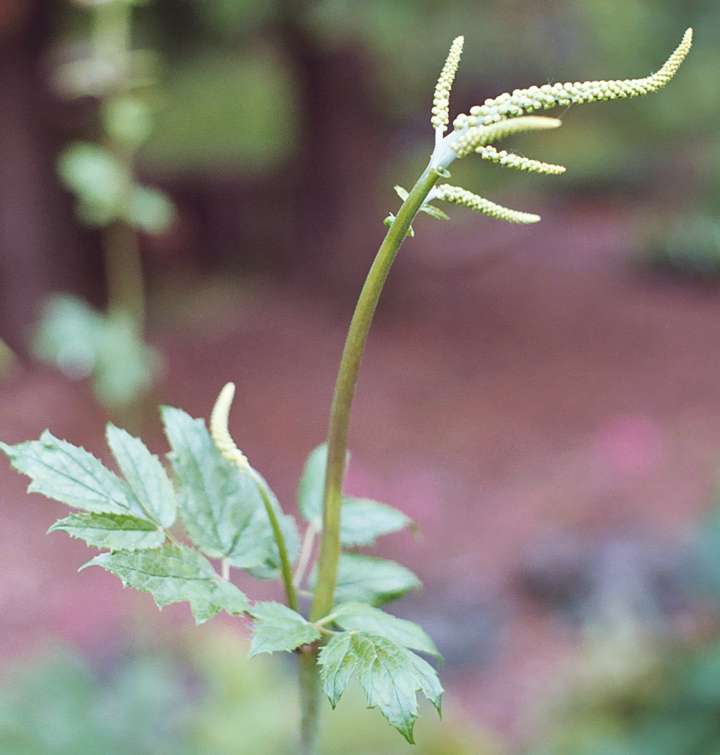
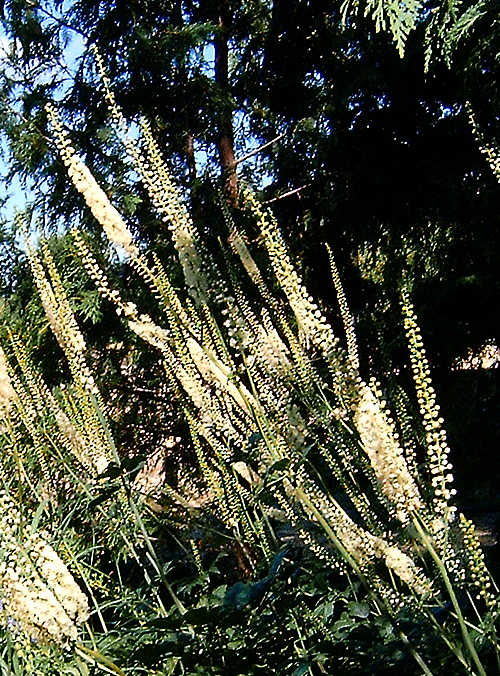
—Cimicifuga racemosa (=Actaea racemosa). (c,h) R-CIMI-21. Packet: $2.50
5 grams: $6.00 BULK OUT OF STOCK - PACKETS ARE AVAILABLE
Click for photo »

'BLACK COHOSH', 'BLACK SNAKEROOT'. Narrow spikes of small white flowers, up
to 2 feet long, in July and August. Bold perennial to 8 feet, with shiny, dark
green compound leaves. E. N. America. Zone 4. Very showy and good in rich moist soil and
part shade. The valuable medicinal roots are one of the best remedies for
problems associated with menopause, PMS, ringing in the ears, and depression.
Seed needs 2 - 10 weeks warm, then 12 weeks cold to germinate. Hold pots 3
years.
—Cimicifuga ramosa atropurpurea (=Actaea
ramosa purpurea). (c,v) R-CIMI-23A. Packet: $3.00
Attractive purple-red palmately-lobed foliage, on a tall hardy perennial to 6
feet, with nodding 16" racemes of small creamy flowers in fall. Kamchatka.
Zone 4. Give 6 weeks warm, then 6 - 8 weeks cold, and hold pots over two years.
CLEOME
—Cleome serrulata. (c,h) R-CLEO-22. Packet: $2.50
Oz: $9.00 BULK OUT OF STOCK - PACKETS ARE AVAILABLE
'ROCKY MOUNTAIN BEE PLANT', 'TU'MI' (Hopi name). Rosy lavender 1/2"
flowers in dense racemes from June to August. Annual to 2 - 3 feet with
trifoliate leaves. N. America. Zone 3. Grown as a bee-crop for a century. Excellent cut
flower or annual hedge. The boiled leaves and flowers are eaten, tasting like
mustard. The Hopi allow it to seed in their corn fields for spring greens, and
they use it in making prayer-sticks. The Tewa of the Rio Grande make pottery
paint with it. The Ramah Navaho boil the young plants 1 - 2 hours and discard
the water. They use a cold infusion of the leaves as a deodorant. The Nightway
god-impersonators drink a tea made of 'a few seeds' to gain a strong voice.
Attracts butterflies. Sow in fall or give cold treatment and plant out when the
ground is still cold. Strong sunlight may help. "If seed isn't scattered
in fall or patted onto thawing soil in earliest spring, the soil is too warm and
the seed does not germinate."—D.S. Larkin, Utah, 1/2001.
COLCHICUM (KOL-chi-kum)
LILIACEAE. Crocus-like cormous perennials from the Mediterranean and Central
Asia, most blooming in late summer and fall, after the narrow leaves wither.
Good in full sun. "Colchicums are most charming and interesting plants
of easy culture."—L.H. Bailey. Seed often slow to germinate.
—Colchicum autumnale. (c,v) R-COLC-2. Packet: $2.50 OUT OF STOCK
'AUTUMN CROCUS', 'MEADOW SAFFRON'. Showy purple or white flowers to 4"
across, blooming in autumn. Hardy perennial with narrow, foot-long leaves.
Europe. Zone 5. The corms and seeds are the source of colchicine, used in
the treatment of gout and to induce chromosome doubling in plant breeding. Give
seed warm/cold/warm, and seedlings will straggle in over 1 - 3 years.
DIPSACUS (DIP-sa-kus)
DIPSACEAE. Tall, mostly hardy biennials and perennials of Eurasia and N. Africa. Valued for the interesting spiny heads used in dried arrangements.
Good in the wild garden or border, sun or part shade Sow in May and: June,
14" deep, to germinate in about 1 - 4 weeks. Seed long-lived.
—Dipsacus sativus. R-DIPS-22. Packet: $3.50 OUT OF STOCK
'TRUE FULLER'S TEASEL'. Pale lilac or white flowers in dense heads, followed
by attractive prickly seed-heads. Hardy biennial to 10 feet. Eurasia. Zone 5.
This is said to be the true fuller's teasel (which I haven't seen in years),
which has hooked bract-tips, so they are used in raising the knap on woolens.
From a respected European grower, but until my plants flower and I'm positive
this is true fuller's teasel, this will be a Reserved Access no refunds for
any reason item!
EUPHORBIA
Dormant species may need cold, nicking, or GA-3.
—Euphorbia enopla. (e,g) R-EUPH-40. Packet: $2.50
'BOKNOORS'. Cactus-like succulent shrub to 1 - 3 feet, with many 2"
thick, 6 - 7 -angled branches with red to purple 1 - 2" spines. Flowers
have striking dark red bracts. S. Africa. Zone 7. CITES Appendix II endangered
species. Germinates in 1 - 3 weeks.
NEW—Euphorbia ferox. (25) R-EUPH-48. Packet: $2.50
'VOETANGEL'. Clumps of ribbed, cactus-like 10" branches with brown
spines. S. Africa. Forms clumps 2 feet across. CITES Appendix II endangered
species. Germinates in 1 - 2 weeks.
—Euphorbia inermis. (e,f) R-EUPH-70. Packet: $2.50
Clumps of foot-long, finger-like, succulent, knobby stems rise from a thick
caudex to 6" across. Small woolly-white flowers in spring and summer. S.
Africa. Zone 9. CITES App. II endangered species. Germinates in 1 - 3 weeks, and
GA-3 may help.
—Euphorbia pentagona. (d,v) R-EUPH-109. Packet: $3.00
Cactus-like shrub to 10 feet, with many 1 1/2" thick, 5 - 8-angled
branches, bright glossy green turning grey with age. Small buff-lavender
flowers. S. Africa. Zone 7. CITES App. II endangered species. Seed dormant, try GA-3.
LEUCHTENBERGIA (look-ten-berg-EE-a)
CACTACEAE. A single endangered species.
—Leuchtenbergia principis. (e,g) R-LEUCH-4. Packet: $2.50
Peculiar cactus with elongated grey-green tubercles tipped with papery
4" spines. Somewhat resembles an Agave. Reaches 2 feet tall, with
golden-yellow 3" flowers. México, where is is used medicinally. A CITES
Appendix I endangered species, cannot be sent out of the U.S. Well-drained soil.
Can bloom in 4 - 5 years. Use GA-3 to germinate in 3 - 4 weeks.
LOBELIA
—Lobelia inflata. (1000) R-LOB-17. Packet: $3.00
'INDIAN TOBACCO'. Light blue 1/4" flowers followed by inflated pods.
Annual to 1 - 3 feet, with oval, 3 1/2" leaves. E. U.S. This medicinal herb
was very popular with the Indians. The herb should be collected in August to
September, and dried carefully. Sow seed on a thin layer of wood ashes or use
GA-3 to germinate in 2 - 4 weeks warm. Very irregular and temperamental
germination.
LUNARIA (loo-NAR-ee-a)
CRUCIFERAE. Old fashioned annuals and perennials grown for their attractive,
sweet-scented flowers and the large, flat, silvery pods used in dried
arrangements. Easily grown, standing poor soil, part shade, and drought. Reseeds
well. Sow early in spring or fall in mild climates.
—Lunaria rediviva. (10,h) R-LUNA-4. Packet: $2.50
'PERENNIAL HONESTY'. Handsome hardy perennial to 4 - 7 feet, with larger and
lighter-colored flowers than L. annua, and with pods much longer than wide.
Blooms in May and June. Europe. Zone 5. An odd and interesting counterpart to the
common species. "A stately plant."—I. Grabo. Seed highly
dormant, needs to be sown in fall for outdoor conditions.
MONODORA (mo-NO-dor-a)
ANNONACEAE. Tropical African trees and shrubs.
—Monodora Myristica. (5) R-MONO-16. Packet: $5.00
25 Seed: $15.00, 100 Seed: $40.00 BULK OUT OF STOCK - PACKETS ARE AVAILABLE
Click for photo »
Flower
'CALABASH NUTMEG', 'AFRICAN NUTMEG'. Spectacular rare tree. Amazing fragrant
flowers that dangle from the tree on 8" peduncles. Each has three large
4" wings that are red netted creamy yellow, around a globe-shaped cream
center. Softball-sized fruits with nutmeg-scented pulp. Tree to 20 - 100 feet,
with drooping 20" leaves. W. Africa. Zone 10. The seeds have a nutmeg flavor, and
are used as a spice and medicinally. Germinates in about 2 months warm. Contrary
to internet myth, the seed is viable for over a year stored dry.
PARIS (PAR-is)
LILIACEAE. Eurasian Trillium-like perennials.
—Paris quadrifolia. (25) R-PARI-24. Packet: $3.00
'HERB PARIS', 'LOVE APPLE', 'TRUE LOVE'. Sends up a single stem with four
6" leaves, from the center of which blooms a single greenish-white flower
with long spidery sepals that remain while the blue-black berry ripens. Hardy
perennial to 8 - 16", for cool moist woodlands. Eurasia. Zone 5. Unusual in
that some years it doesn't send up a shoot, but the rhizome persists. Odd
medicinal uses, allegedly aphrodisiac. Give seed warm, cold, warm.
ROMNEYA (ROM-nee-a)
PAPAVERACEAE. Two species.
—Romneya Coulteri. (d,v) R-ROMN-1. Packet: $3.00
Gram: $6.00, 5 grams: $15.00
'MATILIJA POPPY' (pronounced ma-TEE-lee-ya). A magnificent shrub to 3 - 8
feet, with huge crinkled papery white fragrant flowers to 6" across, with
bright yellow stamens, staying open for several days. Divided leathery
grey-green foliage. Canyons of south coastal California, but surprisingly hardy
and successful in the North if planted by a south-facing wall. Zone 7. GA-3 gives fair
germination in 1 - 4 months, or try burning leaves over the flat in fall, may
take 2 years to sprout. Difficult but worth it.
SCHISANDRA (ski-ZAN-dra)
MAGNOLIACEAE. Ornamental woody vines with red or white flowers, handsome bright green foliage, and drooping clusters of scarlet berries. They twine to about 10 - 20 feet, and thrive in partly shaded moist areas. Male and female plants; grow several for the fruits. They are medicinal and some have edible fruits.
—Schisandra chinensis. R-SCHI-6. Packet: $2.50
1/4 Oz: 16.00
'CHINESE MAGNOLIA VINE', 'WU WEI ZI'. Fragrant white to pink 3/4" flowers
followed by attractive 6" spikes of red berries on female vines. Woody
twiner to 25 feet, with glossy, deep green 4" leaves. China. Zone 4. The
fruits are an important tonic and adaptogen in Chinese medicine. Give seed 8 -
12 weeks prechill.
TRICHOSANTHES (tri-ko-SAN-theez)
CUCURBITACEAE. Tendril -climbing annual or perennial vines grown for food and medicine. Easy in
a warm sunny spot and rich soil.
—Trichosanthes cucumeroides (=Trichosanthes ovigera). (10) R-TRCS-10. Packet: $3.00
10 grams: $15.00
'KARASU-URI'. Vermillion-red egg-shaped 3" fruits on a vigorous
perennial vine to 15 feet, with 3 - 5-lobed 4 - 6" leaves. White flowers
with beautifully-fringed petals. Japan. Zone 7. Forms a large tuberous root that
has been used for starch, and can be lifted and stored over winter in cold
climates. The immature fruits are preserved in salt and miso, and the ripe
fruits used as soap. Has some of the most peculiar-looking seeds I've ever seen!
TROCHOMERIOPSIS
CUCURBITACEAE. A single Madagascar endemic.
NEW—Trochomeriopsis diversifolia. (5) R-TROC-4. Packet: $7.00
Flower photo:
http://www.flickr.com/photos/bos69/3993883900/
Plant and caudex:
http://www.bihrmann.com/caudiciforms/subs/tro-div-sub.asp
Extraordinary flowers with fine, very long white ribbon-like trailing
petals. Rare Madagascar vine forming a large caudex, and having divided glaucous
leaves. Germinates readily in 2 - 4 weeks.