[ Home ] [ Up ] [ Supplement A - C ] [ Supplement D - L ] [ Supplement M-Z ] [ Supplement Vegetables ] [ Seedlist A-AK ] [ Seedlist AL-AN ] [ Seedlist AP-AZ ] [ Seedlist B ] [ Seedlist CA ] [ Seedlist CE-CL ] [ Seedlist CN-CZ ] [ Seedlist DA-DE ] [ Seedlist DI-DZ ] [ Seedlist EA - ER ] [ Seedlist ES - EZ ] [ Seedlist F-G ] [ Seedlist H ] [ Seedlist I-K ] [ Seedlist LA-LE ] [ Seedlist LI ] [ Seedlist LO-LZ ] [ Seedlist M ] [ Seedlist N ] [ Seedlist O-PA ] [ Seedlist PE-PH ] [ Seedlist PI-PZ ] [ Seedlist Q-R ] [ Seedlist SA-SH ] [ Seedlist SI-SZ ] [ Seedlist TA-TO ] [ Seedlist TR-TZ ] [ Seedlist U-V ] [ Seedlist W-Z ] [ Vegetable Seed A - D ] [ Vegetable Seed E - R ] [ Vegetable Seed S - Z ] [ Organic Seeds ] [ Books ] [ Bulk Seed List ]
J.
L. HUDSON, SEEDSMAN,
BOX 337, LA
HONDA, CALIFORNIA
94020-0337 USA
2026 SEEDLIST - ORGANIC SEED LISTING
How to Request Seeds
Request Form for requests sent by
the postal service.
Online Requests for e-mail
requests with PayPal (orders@JLHudsonSeeds.net)
or Zelle (postmaster@JLHudsonSeeds.net) payment only.
Don't forget postage and
packing!
Bulk Seed
ORGANIC SEEDS LISTING
To skip the lecture, and go straight to the list, click here.
One of my earliest memories is of watching my father turn the compost pile. The
sight of the teeming life within the pile, and the warmth and rich scents it
gave off, are still so clear to me that I feel like I could reach out into that
memory, and pull myself through, shedding over a half-century of years and
return to that happy summer day. I learned organic gardening from my father, and
have practiced it to this day. A few years ago, when visiting my father, I
noticed some weed killer in the garage - a strange and unexpected sight, and I
did not realize at the time that it was one of the first signs of the
Alzheimer's that finally killed him. So it was only madness that brought him to
put poison on his land, and this pointed out to me again the madness of
industrial agriculture.
There are now over 8 billion people in the world, and all of us need to eat.
Can this number of people be fed by organic agriculture? Without fossil-fuel
mined phosphates, without fossil-fuel fixed nitrogen? Without fossil-fuel driven
tractors to till, and trucks to take the food to people?
Maybe. We don't know. It would take a massive, worldwide reorganization of human
society to achieve this.
Can this be done?
When the oil runs out, we, or our descendents, will find out.
Until that time, we support an orderly move towards a more sustainable, more
regenerative agriculture. Theoretically, we have the knowledge and the
technology to make this transition with minimal suffering, but we feel it is
unlikely that humanity will choose to take the steps necessary to create a
viable future. Currently, our species is on a path that seems destined to create
a future of the maximum possible human suffering.
Personally, I believe it can be done. We are already producing enough food to
feed over 9 billion people, and I estimate that we could eventually feed
somewhere in the neighborhood of 30 billion people. But do we really want to
turn the planet into a feedlot for human beings who must spend their lives doing
nothing but toiling to produce food? There is an old saying, "The stork
brings fascism." Overpopulation causes totalitarianism.
While we use organic methods ourselves, and we fully support organic
agriculture, we must object to the "organic seed requirement" of
current law. This requires organic growers to plant only organically-grown seed,
otherwise their crop will not be considered "organic."
Most people do not realize that this requirement was inserted into the law at
the request of a large corporate seed company in one of their attempts to gain
control of the organic seed market, or that many in industrial agriculture
support the organic seed requirement because it will be an additional burden on
organic farmers, which will lessen their economic viability.
There are currently some exemptions to the organic requirement, but again, the
corporations are pressing for and "end to the loopholes", and claim
that no matter what the cost of organic seed, or no matter how limited the
selection of organic varieties, that this is no excuse for organic growers to
fail to buy their product.
We are also seeing serious profiteering by a few organic seed suppliers at the
expense of their fellow organic growers, with some organic seed selling for ten
times or more the cost of conventional seed. There is absolutely no excuse for
this - NO organic seed is worth TEN times its conventional counterpart.
While we fully support the move towards the organic production of seed,
we do not believe that there is any solid evidence that organic crops grown from
conventional seed are any different from those grown from organic seed. In over
fifty years distributing seeds, we have seen excellent organic seed as well as
excellent conventional seed, and poor organic and poor conventional seed. We do
believe that organically-grown crops are superior in many ways to those
grown by industrial agriculture. We do believe that when seeds are grown
organically for many generations, that particular strain will be
better-adapted to organic production, but I doubt that anything under ten years
will be significantly better.
The key to the quality of seed lies in the DNA - the genetic content of the
seed, and only secondarily from the conditions of production, harvest, drying,
and storage. Without good DNA, no matter what the conditions of production, the
seed will not be worthwhile to plant.
For example, wild-collected seed is not considered to be "organic". If
a grower wants to produce an organic crop of a medicinal plant, and that seed is
available as certified organic, under current rules she must use the
organic seed, and cannot use the wild-collected seed. Wild populations of
medicinal plants may vary considerably in the specific medicinal properties, or
in adaptation to specific local conditions, and several organic growers have
expressed concern that some medicinal crops in cultivation are in serious need
of the greater genetic diversity that would come from an infusion of wild genes
from wild plants. Under current rules, plants grown from wild seed could never
enter the organic market. This is causing the same kind of genetic uniformity
seen in conventional agriculture, which is contrary to organic principles of
diversity.
Also, many traditional vegetable varieties vary considerably - some growers are
careful about reselection for superior traits, others are not. If a specific
variety is available as "organic", an organic grower would be required
to use the seed, regardless of quality.
We support organic agriculture, and we also support small-scale, family farms.
Should we purchase "organic" seed produced by a large corporation, or
seed from a struggling small farm who does not happen to have organic
certification? What would you do?
We believe that organic growers need the freedom to plant the best seeds and the
best varieties they can find, regardless of how they were produced. We feel that
the dangers of the loss of genetic variation in our food crops by the limitation
of available variety, and the consolidation of control of seeds by corporate
interests, currently far outweigh the advantages of "organic seed".
When we have spoken about our concerns with organic growers, most have heartily
agreed with our views, but a few have taken a very fundamentalist hard-line that
"We support 'organic' no matter what!" and that organic seeds should
be required no matter what other harm this causes. We would suggest that it
would make more sense for these organic purists to also require that organic
growers may not use plastic irrigation pipe (a major source of toxins), or any
fossil fuel or electricity (sources of environmental harm) in their operations
or when transporting their product to market. Should we require that organic
growers use only human and animal power to plow and ox-carts to carry their
produce to market? The "agri-smog" of pesticides from California's
agricultural Central Valley is killing frogs far downwind, high in the Sierra
Nevada. Can any grower downwind of this kind of agriculture be considered truly
"organic"?
In the summer of 2004, we replaced some of our ageing, flexible black
polyethylene waterlines with larger-diameter, more permanent buried PVC pipe
with glued connections. Periodically I emptied the pipeline and refilled it,
checking the expelled air - for over 6 months, it smelled strongly of PVC
solvent, and over a full year later, it still smelled faintly of solvent. The
solvents used in PVC glue are toxic, and no doubt contaminate the water the
pipes carry to our plants - for this reason we flush them before use. Although
miles of PVC pipe are used in organic operations, we know of no other organic
grower that has checked this source of toxins. Should we require that organic
growers use expensive steel pipe? Should we require that water lines not be used
for a year, until all trace of solvent has dissipated into the air? Should we be
absolutists, and make it even harder than it already is for small growers to
remain economically viable, or do we accept the reality that nowhere on the
planet is free of man-made toxins? (Note: An organic grower has let me know that
there is a much-less-toxic alternative available for gluing PVC pipes. Gorilla
Glue makes a less-toxic glue specifically for PVC pipes. I'll be using it
myself! www.gorillapvc.com)
We would like to point out, that while we fully support organic agriculture,
we do not support fundamentalism, irrationality, or superstition, and we
certainly do not support profiteering or corporate attempts to control organic
seed supplies. We are opposed to making organic agriculture into a
fundamentalist religion, and we are opposed to the theft of the word
"organic" by government bureaucracy, and we are opposed to the
corporate takeover of the "organic movement".
"Wait a decade or two and every potato coming out of the state of Idaho
will be labeled 'organic', a word already under very serious stress. The process
will be entirely predictable. The big food companies will buy federal and state
legislation designed to put the small producers out of business, the same way
the meat companies finished off the small packers and processors years ago, by
insisting on hundreds of thousands of dollars worth of stainless steel and other
'sanitary' equipment, all intended to bankrupt the local sausage or ham maker.
Wall-Mart's buying power will drive down organic food prices and start to drive
small farmers to the wall."
—Alexander Cockburn, "Wall-Mart's Coming Lunge into Organic Food",
an article on the corporate takeover of organic and the weakening of organic
standards.
We need to build bridges, not walls. Instead of a black/white -
organic/conventional standoff, with the small-scale grower caught in the
cross-fire, we need to provide for a whole range of possibilities that will
allow farmers to easily move along a spectrum of alternatives towards a healthy
agriculture, rather than building a wall they must vault over.
Take back organic!
ORGANIC SEED LIST
OTC = OREGON TILTH CERTIFIED ORGANIC
SEED
EU = EUROPEAN UNION CERTIFIED ORGANIC (EU Regulation No. 834/2007 + 889/2008)
CCOF = CALIFORNIA CERTIFIED ORGANIC FARMERS
AGROSTEMMA (a-gro-STEM-a)
CARYOPHYLLACEAE. Two showy annuals.
—Agrostemma Githago. (100) AGRS-4. Packet: $2.50 EU
ORGANIC
10 grams: $7.50
Beautiful
Photos
Nice
Flower Photo
Photo
of Seed
'CORN COCKLE'. Large magenta-red to purple 2" wide flowers with darker
veins, carried on graceful, willowy stems. Showy and easily grown hardy annual
to 2 - 3 feet, with narrow, greyish 4 - 5" leaves. Europe. The flowers have
a striking, downy, five-pointed calyx. Germinates in 1 - 2 weeks.
CALENDULA
—Calendula officinalis 'Triangle Flashback'. (25) CALN-7TF. Packet: $2.50 OTC
ORGANIC SEED
1/2 Ounce: $12.00
Striking fully double flowers with maroon petal-backs and faces in pastel
pink shading to yellow in the center. Also called 'Zeolights'. Organically
grown.
CHENOPODIUM (ken-o-POE-dee-um)
CHENOPODIACEAE. Wide-ranging genus of mostly herbs with clustered tiny
flowers. Many grown for ornament, edible greens or grain, aromatic culinary
herbs or medicine. Easily grown and very useful. All germinate in 1 - 3 weeks
unless noted otherwise.
—Chenopodium Quinoa 'Brilliant Rainbow'. (100) CHEN-25BR. Packet: $2.50 OTC
ORGANIC SEED
Ounce: $10.00
Reselected from Rainbow for the brightest, most brilliant colors. Nice!
Germinates in a week.
'QUINOA'. An important high-protein (12 - 19%) grain of the Andes, with good
amino acid balance and 58% starch. A staple for millions of Andeans, the
development of low-elevation types is helping its spread. Seed washed in water
before cooking to remove saponins which protect from pests. Hardy, easily grown
annual to 4 - 6 feet, with large seedheads. The leaves, stem-tips and young
flowers are excellent in salads, having a mild sweet flavor, and very succulent.
Also good cooked like spinach or added to soups. Germinates in 1 - 2 weeks.
NEW—Chenopodium Quinoa 'Magenta Sunset'. (250) CHEN-25MS.
Packet: $2.50 OTC ORGANIC SEED
1/4 Ounce: $7.50
Brilliant magenta-orange seed heads ripening to
red, pink, and orange striped. Selected from Brightest Brilliant Rainbow, good for the cut-flower trade
or consumption. From Shoulder to Shoulder Farm.
COSMOS
—Cosmos sulphureus 'Buddha's Hand'. (100) COS-3BH. Packet: 2.50 ORGANIC
1/4 Ounce: $7.50
Ounce: $20.00
Deep orange semi-double flowers on compact plants to 2 - 4 feet tall.
DELPHINIUM
—Delphinium consolida 'Earl Grey'. (200) DELP-30EG. Packet: $2.50 ORGANIC
Lavender-grey flowers on a tall annual larkspur to 3 - 4 feet. Germinates best at cool temperatures.
DIPLOTAXIS (dip-lo-TAX-is)
CRUCIFERAE. Eurasian annuals and perennials.
—Diplotaxis tenuifolia. (=muralis) (500)
DIPL-24. Packet: $2.50 EU ORGANIC
Gram: $7.50
'WILD ARUGULA', 'SYLVETTA'. Yellow flowers on a hardy perennial to 12",
with aromatic leaves. Mediterranean. Zone 5. Young leaves and flowers eaten raw
in salads, or cooked in dishes for for flavoring. Heat-resistant, a good arugula
substitute in warm climates. Organic.
OCIMUM (OSS-i-mum)
LABIATAE. 'BASIL'. Aromatic tender annuals grown in the herb garden for
their value as seasoning and fragrance. The leaves are widely used in sauces and
soups, the flavor blending particularly well with tomatoes. The clove-like
fragrance has been considered soothing, and a cure for nervous headaches. Basil
tea is said to calm an upset stomach. Start seed indoors 6 - 8 weeks before last
frost, and plant out after all danger of frost is past. Thin to 6" apart.
Basil likes full sun, and all types do well in pots. Harvest fresh leaves
anytime. For drying, cut just before it reaches full bloom. Seed viable 8 - 10
years. Germinates in 1 - 4 weeks.
—Ocimum sanctum. (1000) OCIM-24. Packet: $2.50 OTC
ORGANIC SEED
1/4 Ounce: $10.00
Ounce: $30.00
'HOLY BASIL', 'TULSI'. Sweetly fragrant bushy perennial to 1 - 3 feet, grown
as an annual in cold climates. Profuse purple or white bloom, and sometimes
purplish-tinted foliage. Tropical Asia. Held sacred by the Hindus and grown
around temples. Sections of the stem-bases are used in rosaries. The leaves are
used in salads, and the oil is an effective antibiotic, and the leaves are used
medicinally. Nice, distinctive clove-like flavor, good in cooking, salads, or
for tea. Good in herb breads and herb butters. Good bee plant. Germinates in 1 -
4 weeks. Light and KNO3 helps. Organically grown.
SALVIA
—Salvia officinalis 'Extracta'. (25) SALV-60E. Packet: $2.50 EU
ORGANIC
10 grams: $15.00
'EXTRACT SAGE'. Developed for high oil content of the foliage for extraction. To
2 feet, lilac flowers, grey leaves. Germinates in 1 - 2 weeks.
URTICA (UR-ti-ka)
URTICACEAE. Widespread genus of valuable perennials and annuals with stinging
hairs. Easily grown in rich moist soil in sun or part shade.
—Urtica dioica. (500) URTl-3. Packet: $2.50 EU
ORGANIC
Gram: $5.00
'STINGING NETTLE'. Hardy perennial to 4 - 6 feet, with large oval leaves and
clustered tiny green flowers. N. Hemisphere. Zone 2. Young tops are a delicious
potherb, and are made into wine and beer. Stem fibers provide strong cordage,
and were made into cloth and paper. Leaves, seeds, and roots are valuable
medicinals. Good butterfly plant, and valuable poultry and stock feed. Used as a
rennet, and roots for yellow dye. Germinates in 2 - 4 weeks.
ORGANIC VEGETABLE SEEDS:
AMARANTH
—Amaranth Hopi Red Dye. (500) VAMA-HO. Packet: $2.50
ORGANIC
10 grams: $7.50
Deep purple-red plants to 4 - 6 feet tall, large and vigorous. Leaves are
good greens when young, and the black seeds as grain. The Hopi use the plants to
make a ceremonial red dye. Germinates in 1 - 2 weeks, GA-3 helps.
BASIL
Ocimum Basilicum. Aromatic tender annuals grown in the herb garden
for their value as seasoning and fragrance. The leaves are widely used in sauces
and soups, the flavor blending particularly well with tomatoes. The clove-like
fragrance has been considered soothing, and a cure for nervous headaches. Basil
tea is said to calm an upset stomach. Start seed indoors 6 - 8 weeks before last
frost, and plant out after all danger of frost is past. Thin to 6" apart.
Basil likes full sun, and all types do well in pots. Harvest fresh leaves
anytime. For drying, cut just before it reaches full bloom. Seed viable 8 - 10
years. Germinates in 1 - 4 weeks.
—Basil, Holy Basil. (Ocimum sanctum) (1000) OCIM-24. Packet: $2.50 OTC
ORGANIC SEED
1/4 Ounce: $10.00
Ounce: $30.00
'HOLY BASIL', 'TULSI'. Sweetly fragrant bushy perennial to 1 - 3 feet, grown
as an annual in cold climates. Profuse purple or white bloom, and sometimes
purplish-tinted foliage. Tropical Asia. Held sacred by the Hindus and grown
around temples. Sections of the stem-bases are used in rosaries. The leaves are
used in salads, and the oil is an effective antibiotic, and the leaves are used
medicinally. Nice, distinctive clove-like flavor, good in cooking, salads, or
for tea. Good in herb breads and herb butters. Good bee plant. Germinates in 1 -
4 weeks. Light and KNO3 helps. Organically grown.
BEAN
—Bean Fava Sweet Lorane. (30) VBEA-FSL. Packet: $2.50 OTC
ORGANIC SEED
1/4 pound: $8.00
Small-seeded light colored beans bred for low tannin and sweet flavor.
Re-selected by Alan Adesse to recover the best color and taste, Sweet Lorane can
be eaten fresh like chickpeas or dried for soup. Very cold hardy and good
nitrogen fixer. Organic.
—Bean Painted Pony. (50) VBEA-PP. Packet: $2.50 ORGANIC
1/4 Pound: $10.00
Great for both fresh snap beans or dried for soup beans. Long slender bright
green pods, mature beans pretty brown and white, keeping their color after
cooking. Bush type. Organically grown.
—Bean Royalty Purple Pod. (50) VBEA-RP. Packet: $2.50 ORGANIC
Pound: $7.00
Bushy purple plants with purple flowers and 5" bright purple pods. Very
tender and tasty, turning green when cooked. Germinates fine in cold wet soil.
Introduced in 1957.
—Bean Whipple. (25) VBEA-WP. Packet: $2.50 OTC
ORGANIC
1/4 Pound: $6.00
Family heirloom from the Willamette Valley in Oregon, this is a dry bean for
soups and stews. Beans are dark purple-red with white markings, and incredibly
flavorful. Bushy plants with an occasional runner. Organically grown.
—Bean Zargana of Nestos. (20) VBEA-ZN. Packet: $2.50 OTC
ORGANIC
1/4 pound: $8.00
Beautiful red-podded snap pole bean from Nestos, Greece. Early and productive,
rare in the U.S. The dry beans are shades of buff, pink, lavender, purple.
"Question with boldness even the existence of God; because if there be one,
He must approve the homage of Reason rather than that of blindfolded fear."—Thomas
Jefferson.
CELERY
—Celery Chinese Pink. (300) VCEL-CP. Packet: $3.00 ORGANIC
Vibrant candy-pink slender stems, green leaves. A classic Chinese celery with strong flavor—not eaten raw but used in stir-fry, soups, and stews. Good eaten young as an herb, like cilantro or parsley. Organic.
—Celery Redventure (=Giant Red Reselection). (500) VCEL-R. Packet: $3.00 OTC
ORGANIC SEED
1/4 Ounce: $9.00
Tall green stalks blushed deep red, with rosy-yellow hearts. More flavorful than
green celery. Cold hardy. Organically grown.
CORN
NEW—Six Shooter. (100) VCOR-SIX. Packet: $3.00 ORGANIC
1/4 Pound: $12.00
Pound: $30.00
It's getting hard to find open-pollinated sweet
corns now, and this is a nice one. Produces large ears
of tender white kernels. Under good conditions it can
give you 6 full-sized ears per stalk, hence the name.
Also makes 'tillers', smaller side shoots that don't
take energy from the main ears and can be left to
form smaller ears. Reaches 7 - 8 feet tall. Sold by R.H. Shumway Seeds in 1968, and maintained and
spread by the Pendergrass family in Tennessee. Organic.
—Corn Sunshine. (50) VCOR-SUN. Packet: $2.50 OTC
ORGANIC
1/4 Pound: $7.50
Rare short-season sweet corn with deep yellow kernels and old-fashioned flavor.
Ripens in about 75 days from transplanting. Developed by Albert Yeager in the
1920s, very popular through the 1990s, when it disappeared. Now revived by Alan
Adesse in limited quantities.
Popcorn Varieties:
Popcorns are smaller than other types, and are harvested after the cobs have
dried on the stalks. Valued for its ability to pop when heated, it has been
regarded as a festive food since ancient times.
—Popcorn Pennsylvania Dutch Butter. (75) VCOR-PND. Packet: $2.00 ORGANIC
SEED
Ounce: $5.00
1/4 Pound: $10.00
Heirloom grown since the 1880s, with melt-in-your-mouth tenderness and rich
flavor—absolutely one of the best-tasting popcorns you can find. Plump white
kernels on 4 - 6" ears. In Italy, popcorn is ground for meal, and this
variety makes especially good white polenta. Organic seed.
CORN SALAD or MACHE
—Corn Salad Light Green Lantern. (1000) VCOS-LG. Packet: $3.00 OTC
ORGANIC
1/2 Ounce: $12.00
Dense rosettes of light green leaves with a sweet, nut-like taste. Very tender,
great in salads with toasted walnuts, goat cheese, and cherry tomatoes.
FENNEL
—FENNEL Bronze. (=Rubrum) (50) FOEN-1B. Packet: $2.50 OTC
ORGANIC SEED
1/4 Ounce: $7.50
Foeniculum vulgare var. rubrum. Feathery reddish bronze foliage; a
very pretty 'smoky' effect. To 4 feet. Hardy short-lived perennial. Chopped
leaves nice in salads or sauces, seeds for seasoning.
KALE
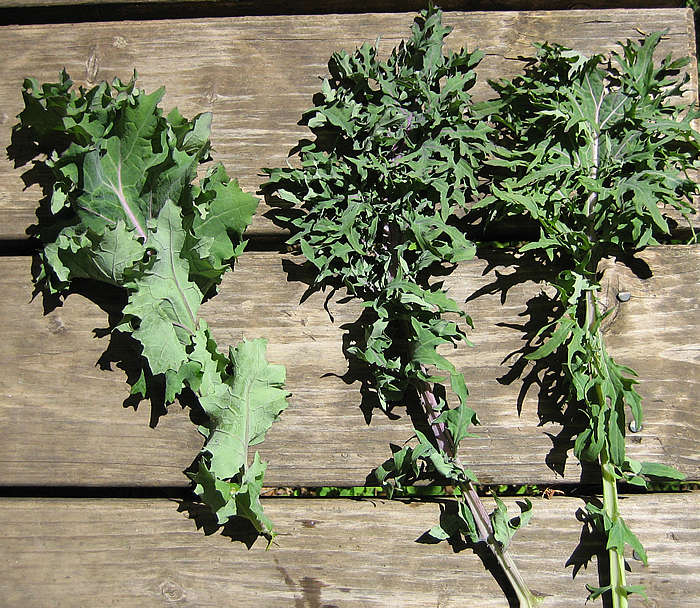
—Kale Lacinato Rainbow. (250) VKAL-LR. Packet: $2.50 OTC
ORGANIC SEED
1/4 Ounce: $8.00
Click for photo » 
Deeply savoyed long narrow leaves overlaid with shades of purple,
blue-green, and red. A variety of leaf shapes varying from nearly entire, to
very frilly and divided. Very vigorous and cold hardy, perennial in mild
climates. Organically grown.
—Kale Red Ursa. (50) VKAL-RU. Packet: $2.50 OTC ORGANIC
Ounce: $12.00
Outstanding variety with broad, slightly frilled leaves with red veins and
purple stems. Great for salad mixes. Bolting stems from over-wintered plants are
sweet and tender—eat like asparagus. Organically grown seed.
—Kale White Russian. (50) VKAL-W. Packet: $2.50 OTC
ORGANIC
1/4 Ounce: $7.50
Deeply ruffled dusky green leaves with white veins and mid-ribs. Stands wet
soil, vigorous and productive. Nice in salads and braising mixes. In 1995 Garden
City Seeds in Montana judged this to be the most cold-hardy and best tasting
kale. Organically grown seed.
—Kale Wild Garden Mix. (100) VKAL-WGX. Packet: $2.50 ORGANIC
SEED
1/4 Ounce: $6.00
Ounce: $12.00
Another diverse gene pool from Wild Garden Seed, begun by crossing Siberian and
Red Russian, it now produces a wide variety of leaf types colors, all developed
for summer sowing, fall harvest, and overwintering in mild climates. All are
sweet and tender, not as strong-tasting as European kales.
LEEK
—Leek Blue Solaise. (100) VLEE-BL. Packet: $2.50 ORGANIC
SEED
French heirloom from the 1800s, with large sweet-flavored stalks and blue-green
leaves that turn vivid violet in cold weather. Extremely hardy, excellent in
short-season areas, sown in early summer for winter harvest. Organic.
LETTUCE
Lactuca sativa. Sow in rows 1 foot apart as early as the ground can
be worked, not covering the seed, as light is needed for germination. Thin to
8" apart as they develop. Or, plant in flats 1 month before planting out.
Transplant carefully. Lettuce prefers cool to moderate temperatures, and is best
sown in spring or early fall in a light, well-drained soil. Give shade in hot
weather. For a continual crop, sow every few weeks, as long as desired.
There are four basic types of lettuce: Loose-Leaf, Butterhead, Crisphead, and
Cos or Romaine. Within these types there are also: Winter Lettuces, which are
more adapted to cold and will withstand ordinary winters with little care.
Spring Lettuces head rapidly and are sown just after winter. Summer Lettuces are
usually larger and do not run to seed as fast in hot weather.
NEW—Lettuce, Annie Oaky. (150) VLET-ANN. Packet: $3.00 ORGANIC
Very pretty small oak leaf type, glowing deep-red ruffled outer leaves with green-gold hearts. Crisp, crunchy, compact and petite. Another beauty from breeder Frank Morton. Organic.
NEW—Bloodstone. (200) VLET-BL. Packet: $3.00 ORGANIC
Beautiful small heads of rounded leaves with deep
red streaks on green. Not only tender and tasty, but
highly ornamental. A Frank Morton gem. Organic.
—Lettuce Camo Oakheart. (200) VLET-CO. Packet: $2.50 ORGANIC
1/4 Ounce: $20.00
Beautiful mix of dense-heading small-leaf plants in rich colors of ruby, deep purple, green, and gold. Another beauty from Wild Garden. Organic.
—Lettuce Hyper Red Rumple Waved. (250) VLET-HY. Packet: $2.50 OTC
ORGANIC
1/4 Ounce: $12.00
Vivid deep purple-red leaves, strongly savoyed, semi-cos, with nice tender
crumpled hearts. Remarkable summer color, cold-hardy into autumn. One of the
most dramatic red lettuces from Wild Garden selections. Organically grown.
—Lettuce Jack Ice. (200) VLET-JI. Packet: $2.50
ORGANIC
Unusual dark green crisp-leaf variety, with striking deeply-toothed edges. Open,
upright heads, crunchy, juicy, and sweet. Nice hefty plants, resistant to downy
mildew and tip burn. Organically-grown.
—Lettuce Lava Lamp Romaine. (200) VLET-LLR. Packet: $2.50 ORGANIC
1/4 ounce: $20.00
Tall heads are colorful all the way to the hearts, brightly marbled and streaked
with red, yellow, green, and white. Thick and crunchy, stays sweet and tasty
even when near bolting. Another beauty from Frank Morton. Organically-grown.
—Lettuce Mayan Jaguar. (150) VLET-MJ. Packet: $3.00 OTC
ORGANIC SEED
Upright romaine type, with green ruffled leaves with dark red spots. Sweet,
juicy, and crunchy, with rose-pink hearts. Another nice one from Frank Morton.
Organically grown.
—Lettuce Really Red Deer Tongue. (200) VLET-RRD. Packet: $2.50 ORGANIC
Long pointed triangular leaves are a deep, dark burgundy-red with white
mid-ribs. Gives dark red leaves for cutting, plus a tender, buttery heart. Yet
another fantastic variety from Frank Morton, selected for color, heat tolerance,
and vigor. Organically-grown.
—Lettuce, Strawberry Oakheart. (100)
VLET-STO: Packet: $4.00 ORGANIC
Beautiful small heads of tall, pointed leaves, deep red outside, strawberry-red and gold inside. Tender and not bitter, the bolting stems are crisp and delicious too. Yet another jewel from Frank Morton's breeding program. Organic.
—Lettuce Wild Garden Mix. (250) VLET-WX. Packet:
$2.50 OTC ORGANIC SEED
1/4 Ounce: $12.00
The most diverse lettuce mix ever! From the premier lettuce growers at Wild
Garden Seeds, this mix contains every variety they have, plus unreleased
works-in-progress. Loose leaf, butter, crisp head, romaine—red, purple, green,
bronze, speckled—frilly, round, narrow, wide. Amazing diversity for your
salads! Organically grown.
MELON
—Melon Delice de la Table. (40) VMEL-DT. Packet: $2.50 OTC
ORGANIC
1/4 Ounce: $7.50 NEW
PRICE
Very rare, nearly extinct French heirloom from the 1800s. Deeply ribbed
melons with orange and white mottled skin, sweet orange flesh. Another fine
variety brought back by the Seed Savers Exchange.
MILLET
—Millet German Foxtail. (1000)
VMIL-GF. Packet: $2.50 ORGANIC
Ounce: $5.00
1/4 Pound: $15.00
Setaria italica. One of the oldest crops, this annual summer-growing grass gives both excellent grain and high-quality hay. Tolerates a dry growing season. First grown in China about 6500 BCE, and it remains an important crop
for arid regions. Organic.
MUSTARD
Brassica juncea var. integrifolia. Mustard leaves are excellent
greens with a sharp pungent flavor. Boiled like spinach, they become tender and
not at all bitter. Very good in soups, or as simple cooked greens served with a
little melted butter.
Plant in late spring or early summer, or in frost-free climates, sow in fall and
early winter. Prefers a rich soil and abundant moisture for fast growth, but
will produce well in any soil. Thin to 6" apart in rows 18" apart. A
cool weather crop.
—Mustard Dragon Feathers Mix. (250) VMUS-DF. Packet: $2.50 ORGANIC
1/4 Ounce: $6.00
Beautiful mix of textures and forms—frilled, rounded, feathery, in shades of green, gold, and purple. Highly flavorful, great for salad mixes. Bred by Frank Morton at Wild Garden. Organic.
—Mustard Vibrant Ultraviolet. (100) VMUS-VU. Packet: $2.50 ORGANIC
SEED
1/4 Ounce: $6.00
Extraordinary color in a mustard—in cold weather the lobed leaves turn a deep,
dark violet with vivid magenta-pink veins and sterns. Color like no other! Mild
flavor, perfect for winter salads. From Frank Morton of Wild Garden Seeds.
Organic.
QUINOA VARIETIES: Chenopodium Quinoa
'QUINOA'. An important high-protein (12 - 19%) grain of the Andes, with good
amino acid balance and 58% starch. A staple for millions of Andeans, the
development of low-elevation types is helping its spread. Seed washed in water
before cooking to remove saponins which protect from pests. Hardy, easily grown
annual to 4 - 6 feet, with large seedheads. The leaves, stem-tips and young
flowers are excellent in salads, having a mild sweet flavor, and very succulent.
Also good cooked like spinach or added to soups. Germinates in 2 weeks.
—Quinoa Brilliant Rainbow. (100) CHEN-25BR. Packet: $2.50 OTC
ORGANIC SEED
Ounce: $10.00
Reselected from Rainbow for the brightest, most brilliant colors. Nice!
Germinates in a week.
SPINACH
—Spinach Merlo Nero. (100) VSPI-MN. Packet: $3.00 OTC
ORGANIC
Ounce: $12.00
Italian variety with heavily crinkled, savoyed leaves. Known for its excellent
flavor. Large plants. Does best in cool weather.
TOMATO
—Bundaberg Rumball. (50) VTOM-BUN. Packet: $3.50 ORGANIC
Dwarf compact plants to 3 feet, bearing heavy
crops of medium-sized round cherry tomatoes, brick-red to brown, with a pleasant mild flavor. Developed
by the Dwarf Tomato Project from a cross between
Black from Tula and Budai Torpe, selected by
Richard Allen, introduced in 2015. Organic.
—Tomato Ferris Wheel. (50) VTOM-FE. Packet: $3.00 OTC
ORGANIC
Large dusky-pink beefsteak tomatoes known for their superb flavor. Tall vigorous vines. Fruits reach 16 - 32 ounces. They may crack and don't store well, but the fantastic taste makes them a favorite for the home garden. An old commercial tomato from the Salzer Seed Company in 1894. Popular for decades, it eventually disappeared, to be revived by Craig LeHoullier in the 1990s.
—Tomato Hartman's Yellow Gooseberry. (100) VTOM-HYG. Packet: $3.00
ORGANIC
Bright lemon-yellow cherry tomatoes growing in long clusters. Small to
medium-size, with delicious sweet, mild flavor. Grown since the 1800s.
Indeterminate. Organic.
—Uluru Ochre. (50) VTOM-UL. Packet: $3.00 ORGANIC
Medium to large slightly lumpy tomatoes, an unusual yellow-orange-brown ochre color. Tender,
juicy, sweet, and tasty. From the Dwarf Tomato
Project, a cross of Orange Heirloom and Rosella
Purple. Sturdy plants to 4 feet. Selected and named
by Patrina Nuske Small, named for the great Australian monolith Uluru (Ayres Rock). Organic.
[ Home ] [ Up ] [ Supplement A - C ] [ Supplement D - L ] [ Supplement M-Z ] [ Supplement Vegetables ] [ Seedlist A-AK ] [ Seedlist AL-AN ] [ Seedlist AP-AZ ] [ Seedlist B ] [ Seedlist CA ] [ Seedlist CE-CL ] [ Seedlist CN-CZ ] [ Seedlist DA-DE ] [ Seedlist DI-DZ ] [ Seedlist EA - ER ] [ Seedlist ES - EZ ] [ Seedlist F-G ] [ Seedlist H ] [ Seedlist I-K ] [ Seedlist LA-LE ] [ Seedlist LI ] [ Seedlist LO-LZ ] [ Seedlist M ] [ Seedlist N ] [ Seedlist O-PA ] [ Seedlist PE-PH ] [ Seedlist PI-PZ ] [ Seedlist Q-R ] [ Seedlist SA-SH ] [ Seedlist SI-SZ ] [ Seedlist TA-TO ] [ Seedlist TR-TZ ] [ Seedlist U-V ] [ Seedlist W-Z ] [ Vegetable Seed A - D ] [ Vegetable Seed E - R ] [ Vegetable Seed S - Z ] [ Organic Seeds ] [ Books ] [ Bulk Seed List ]