COMPOSITAE. 'CONE FLOWER'. Bold herbaceous North American perennials with large, showy, daisy-like flowers and thick, medicinal roots. They are some of our finest natives, giving 2 months or more of late summer bloom, good for cutting. Easy in the border or wild garden, doing well in rich, sandy loam in warm sunny spots. Likes lime.
—Echinacea angustifolia. (250) ECHI-1. Packet: $2.50
1/4 Ounce: $7.50
Ounce: $16.00
'BLACK SAMPSON CONEFLOWER'. Orchid or violet 2" wide flowers. Hardy perennial to 2 feet, with 8" leaves. Plains states. Zone 3. The root is a valuable medicine, and was used by the Sioux against septicemia, rabies, snakebites, etc., and widely in modern times against infection. It is said to stimulate the immune response, production of white blood cells, increase lymphatic filtration, etc. Germinates in 1 - 2 weeks, some lots need 6 - 8 weeks cold.
—Echinacea pallida. (100) ECHI-19. Packet: $2.50
Ounce: $9.00
1/4 Pound: $27.00
'PALE PURPLE CONEFLOWER'. Striking wildflower. Showy large flowers with narrow drooping 1 1/2 - 3 1/2" long petals flushed rosy purple, and large dark purple-brown centers. Hardy perennial to 3 - 5 feet tall. Illinois to Texas. Zone 3. A long-lived plant, it will make a great display year after year. Highly valued by the Indians as a medicinal plant, its roots are prized by herbalists. Like E. purpurea and angustifolia, it was used as a universal panacea. It stimulates the immune system and production of white blood cells (T-cells), increases lymphatic filtration, possesses tumor-inhibiting properties, is effective against bacterial and viral infections, helps wound healing, is anti-allergy, etc. Germinates in 2 - 3 weeks, some lots need 6 - 8 weeks cold.
—Echinacea purpurea. (100) ECHI-27. Packet: $2.00
Ounce: $6.00
1/4 Pound: $18.00
Click for photo »
 (With Allium jajlae)
'PURPLE CONEFLOWER'. Large, handsome, reddish purple 4" wide flowers with darker centers, on a hardy perennial to 2 - 5 feet. E. U.S. Zone 3. An excellent long-lived perennial. Valued as a universal panacea by the Plains and Eastern Indians, the root was used for a wide variety of ailments. They are still quite popular, being especially valued in Europe, where they are frequently employed as a non-specific immune system stimulant effective against bacterial and viral infections. Germinates in 2 - 3 weeks.
—Echinacea tennesseensis. (25) ECHI-36. Packet: $3.00
'TENNESSEE CONEFLOWER'. Rosy purple 3" flowers with upturned petals, in summer. Rare hardy perennial to 2 - 3 feet, with narrow, dark green foliage. Only a few wild stands in Tennessee, it was listed as endangered until 2011. Zone 5. A fine example of preservation through dissemination. Germinates in a few weeks, prechill helps.
ECHINOPS (e-KY-nops)
COMPOSITAE. 'GLOBE THISTLE'. Handsome hardy Old World biennials and perennials grown for their large showy globular blue, violet or white heads, which are valued florist material, and also make good dried flowers. Striking plants, best in colonized clumps, their metallic heads making a bold effect. Attractive to bees. Good in dry, light, well-drained soil. Easy from seed sown January on, up to 2 months before fall frosts. Germinates in 2 - 3 weeks, or up to 2 months. Seed viable 2 years or more.
—Echinops bannaticus 'Blue Glow'. (25) ECHN-2B. Packet: $2.50
Round dark blue 1 - 2" flower-heads in mid- to late summer. Hardy perennial to 3 - 4 feet, with grey woolly stems and thistle-bike leaves. SE Europe. Zone 5. Will rebloom dead-headed. "Undemanding plant good for hot dry areas and poor soil."—N. Aiello, Wisconsin. Germinates in 1 - 2 weeks.
—Echinops sphaerocephalus 'Arctic Glow'. (10) ECHN-22AG. Packet: $2.50
Large white balls of flowers on red stems, from June to August. Thistle-like hardy perennial to 32". The red stems are a striking contrast to the white flowers and green leaves, making an excellent cut flower. Choice! Germinates in 1 - 2 weeks warm.
ECHIUM (EK-ee-um)
BORAGINACEAE. Showy Mediterranean annuals and perennials, some spectacular giants. Easily grown in sunny, dry, poor, well-drained soil in warm areas and near the seacoast. They all attract bees, and one is lizard pollinated! Most germinate in 3 - 4 weeks.
—Echium fastuosum. (50) ECHM-4. Packet: $2.50
1/4 Ounce: $7.50
Ounce: $15.00
1/4 Pound: $40.00
Click for photo »

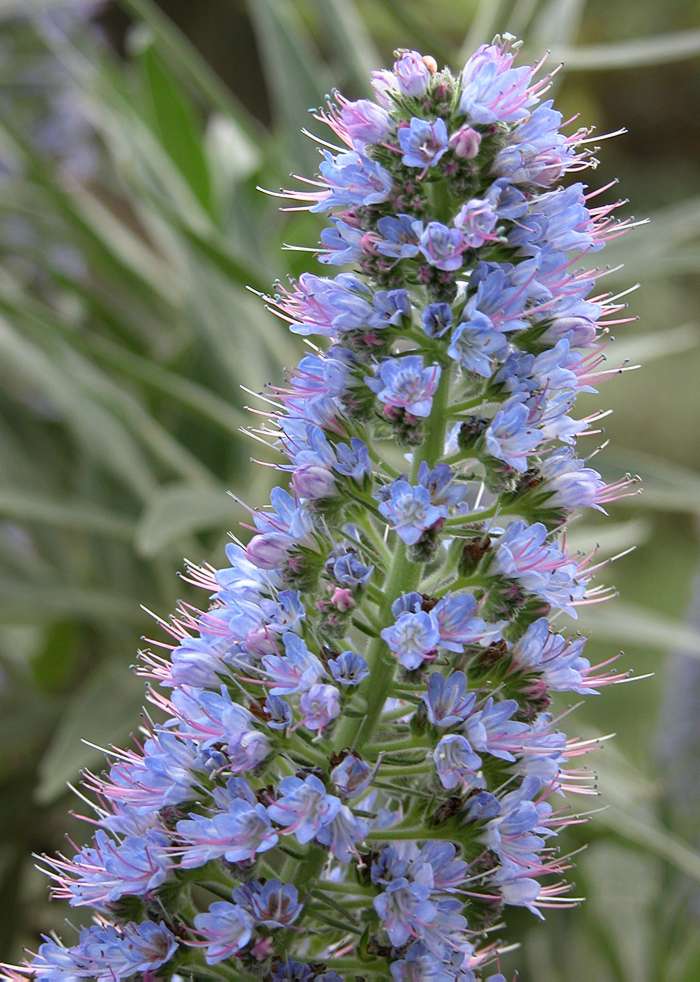
'PRIDE OF MADIERA'. Dramatic spikes of dark blue-purple 1/2" flowers with red stamens, in May and June. Shrub to 6 feet, with grey-green narrow leaves. Canary Islands. Hardy to about 5 - 10°F. Good in coastal California or the cool greenhouse. Germinates in 1 - 3 weeks warm.
—Echium russicum. (50) ECHM-10. Packet: $2.50
Deep red 1/2" flowers with long-exserted stamens, in dense foot-long racemes. Bushy hardy biennial or short-lived perennial to 2 - 3 feet, with narrow, pointed, 4" silvery-fuzzy leaves. Europe and W. Asia. Zone 3. Germinates in 1 - 3 weeks or so.
—Echium vulgare. (100) ECHM-12. Packet: $2.50
10 grams: $14.00
CANNOT BE SHIPPED TO MONTANA
Click for photo »

'VIPER'S BUGLOSS', 'BLUE-WEED'. Showy biennial with numerous flowers in curved spikes. The flowers open bright rose, then turn brilliant blue. June and July. Hardy biennial to 2 - 3 feet. Eurasia. Zone 3. An excellent bee-plant. Was used medicinally against poisons and venom, hence the name. "...really brings butterflies and bees to my garden."—T. Vogelsang. Germinates in 1 - 4 weeks.
—Echium Wildpretii. (50) ECHM-14. Packet: $2.50
Ounce: $45.00
Click for photos »
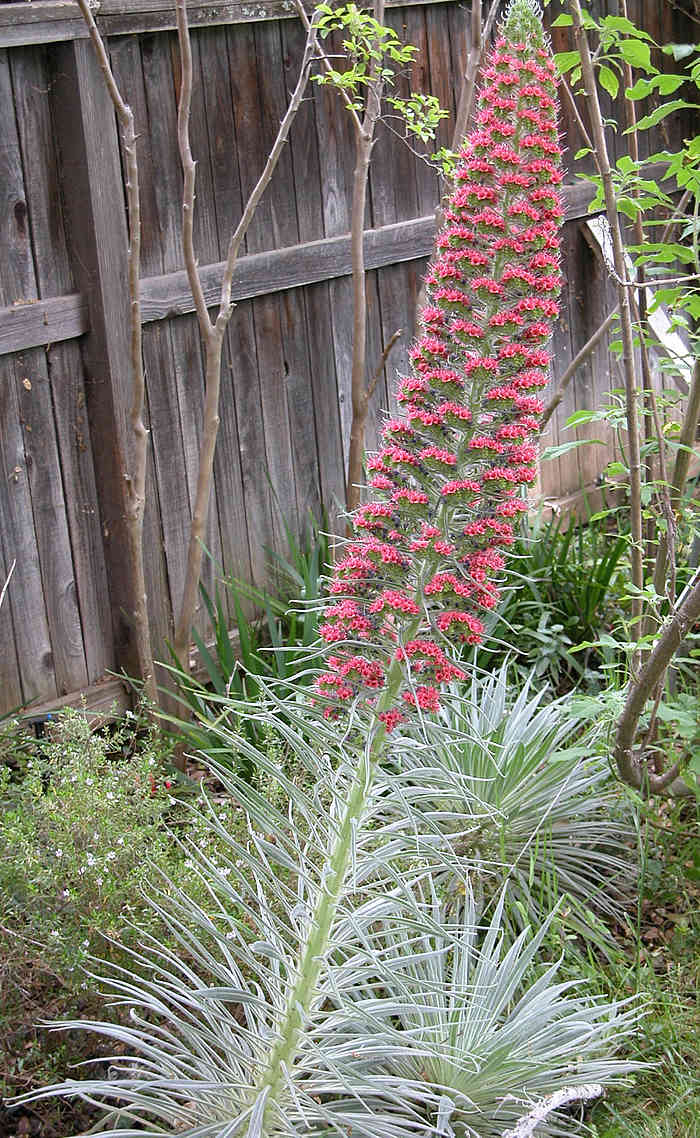
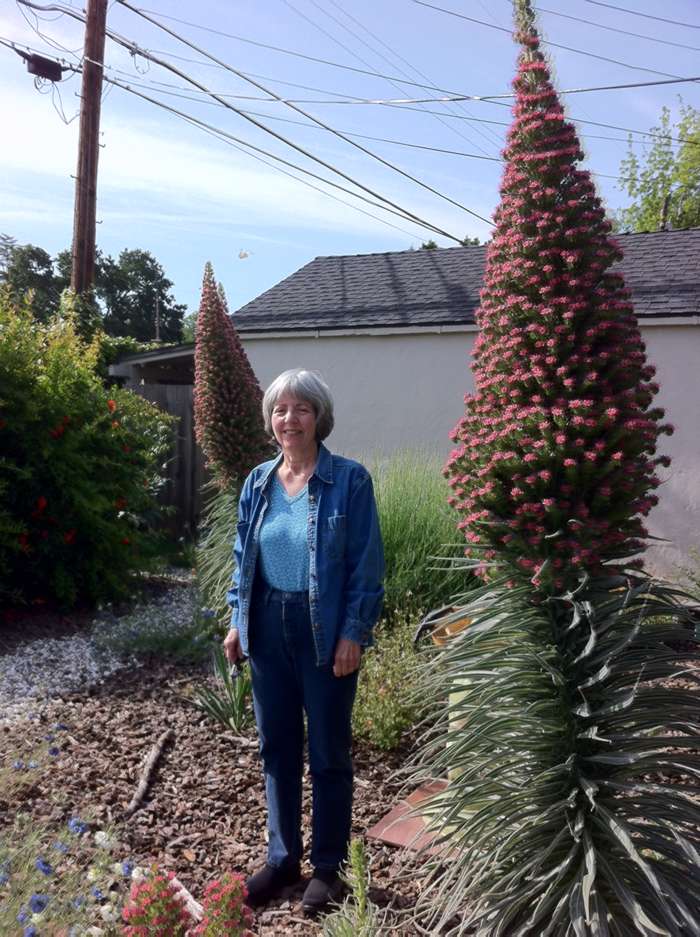
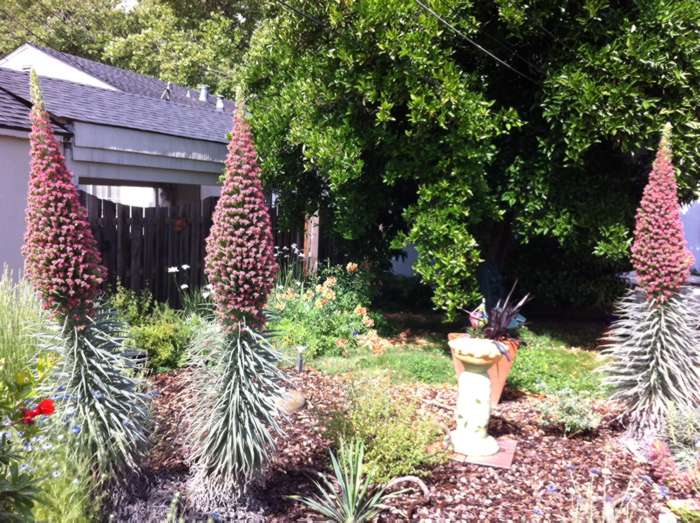
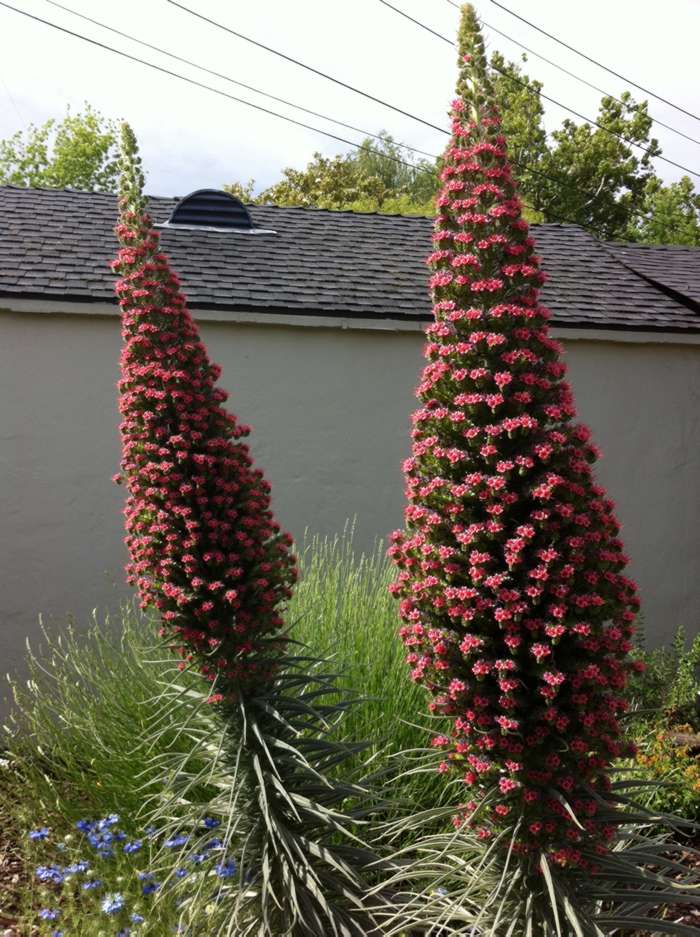


'TOWER OF JEWELS'. Rosy red flowers with long-exserted stamens, in huge tapered conical clusters up to a foot thick and 10 feet tall, creating a striking effect. Biennial with narrow downy leaves. Canary Islands. Zone 9. In cold climates hold over winter in a tub in the greenhouse, and plant out the second spring. A real traffic-stopper here in California. Germinates in 1 - 6 weeks warm. Some lots partially dormant and need GA-3 for best germination. This is the true species and comes true from seed, no hybrids.
ECLIPTA (e-KLIP-ta)
COMPOSITAE. Several warm-region species.
—Eclipta alba. (100) ECLI-4. Packet: $2.50
'BRINGRAJ', 'MO-HAN-LIAN'. Small white daisies on an annual to 1 foot, with narrow leaves. Tropics. An Ayurvedic liver tonic, the juice used to help hair grow and stay dark, to lower blood pressure, and promote longevity and memory. Immune system stimulant, anti-inflammatory, anti-diabetic, and has activity against AIDS. Controls soil nematodes and is antifungal. African sorghum and millet seeds treated with Eclipta extract had almost double the vigor and yield. Needs light and heat to germinate in 1 - 8 weeks, likes moisture.
Treatment of sorghum and millet with Eclipta: http://www.danseed.dk/symposium/~/media/DanSeed/docs/pdf/Symposium2010/S%C3%B8gaard%20Lund.ashx
http://scialert.net/fulltext/?doi=ajppaj.2008.40.47
Overview of medicinal uses: http://www.pharmatutor.org/articles/phytochemical-and-pharmacological-profile-of-eclipta-alba
ELEUSINE (el-you-SEE-ne)
GRAMINEAE. Tufted annual grasses grown for ornament and as a grain in Africa and India. Easy.
—Eleusine coracana 'Green Cat'. (100) ELEU-6G. Packet: $2.50
Click for photo »
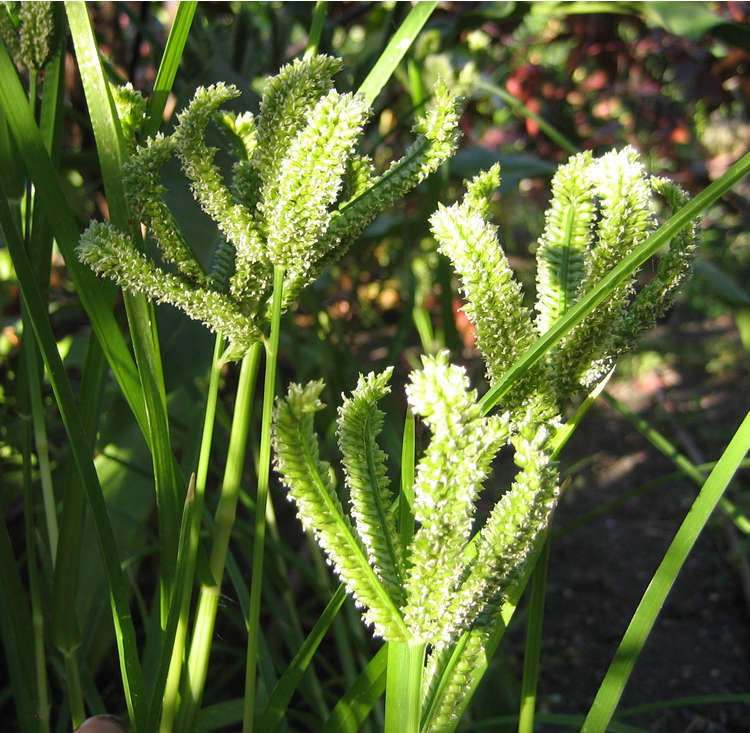
An improved variety with large heads, good for grain or as an unusual cutflower material. Germinates in 1 - 3 weeks.
'DRAGON'S CLAW MILLET', 'RAGI'. Annual to 2 - 3 feet, with heads resembling a dragon's foot. Africa and Asia. Gives a good yield of grain and is grown for this purpose in Africa, Asia and the U.S. It is a fine cereal, and is made into flour. Made into a beer called M'Poko in Africa. Eaten as a vegetable in Indonesia. The most productive cereal in India. Yields up to 2000 pounds per acre. The earliest African agriculture, since 5000 B.P. Germinates in 1 - 3 weeks.
ELSHOLTZIA (el-SHOLT-zee-a)
LABIATAE. Eurasian and African plants, often aromatic. Easily grown late-blooming plants, valued for their dense spikes of flowers. Full sun.
—Elsholtzia Stauntonii. (100) ELSH-22. Packet: $3.00
Rosy purple flowers in dense 4 - 8" spikes in September and October. Aromatic shrubby perennial to 5 feet, with 5" leaves. N. China. Zone 4. Germinates in 1 - 2 weeks warm.
ELYMUS (e-LEE-mus)
GRAMINEAE. Tall perennial grasses grown for ornament and grain.
—Elymus glaucus. (100) ELYM-14. Packet: $2.50
'BLUE WILD RYE'. Variable bunch grass with dense 4 - 8" spikes on long stems. W. N. America. Zone 5. This northern California form makes nice green clumps to 3 - 5 feet, good to naturalize in oak woodlands. The seeds were eaten. Germinates in 1 - 2 weeks.
EPILOBIUM (e-pi-LOW-bee-um)
ONAGRACEAE. 'WILLOW HERB'. Showy hardy perennials with willow-like leaves and large spikes of deep pink, crimson, white or yellow flowers of striking beauty. At their best in moist places or at the waters edge, but are well adapted to the border, meadow and wild-garden. Easy from seed. Sow on the surface to germinate in 1 - 2 weeks.
—Epilobium angustifolium. (500) EPIL-4. Packet: $2.50
Click for photos »
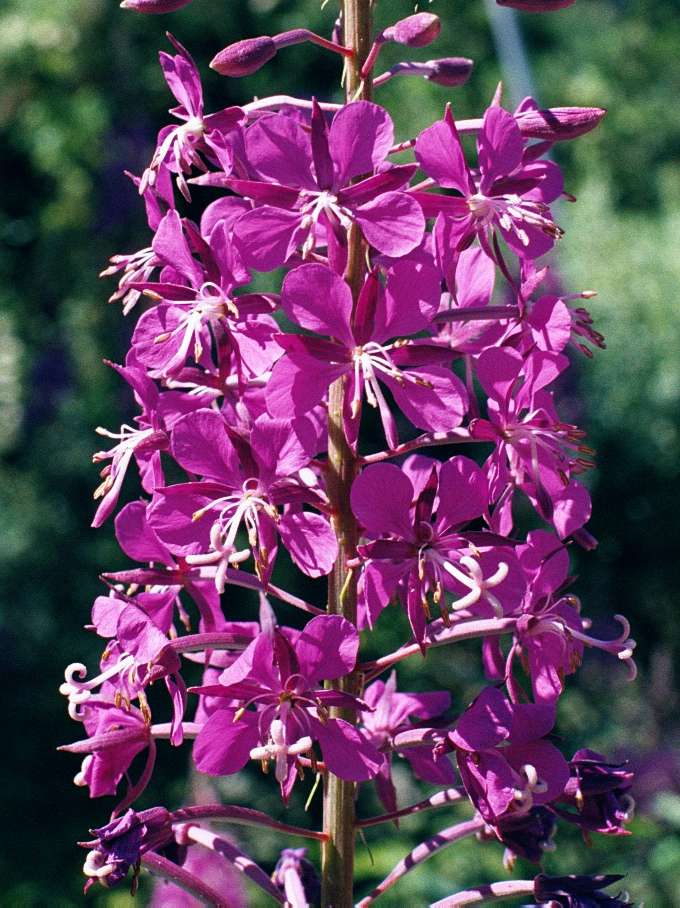
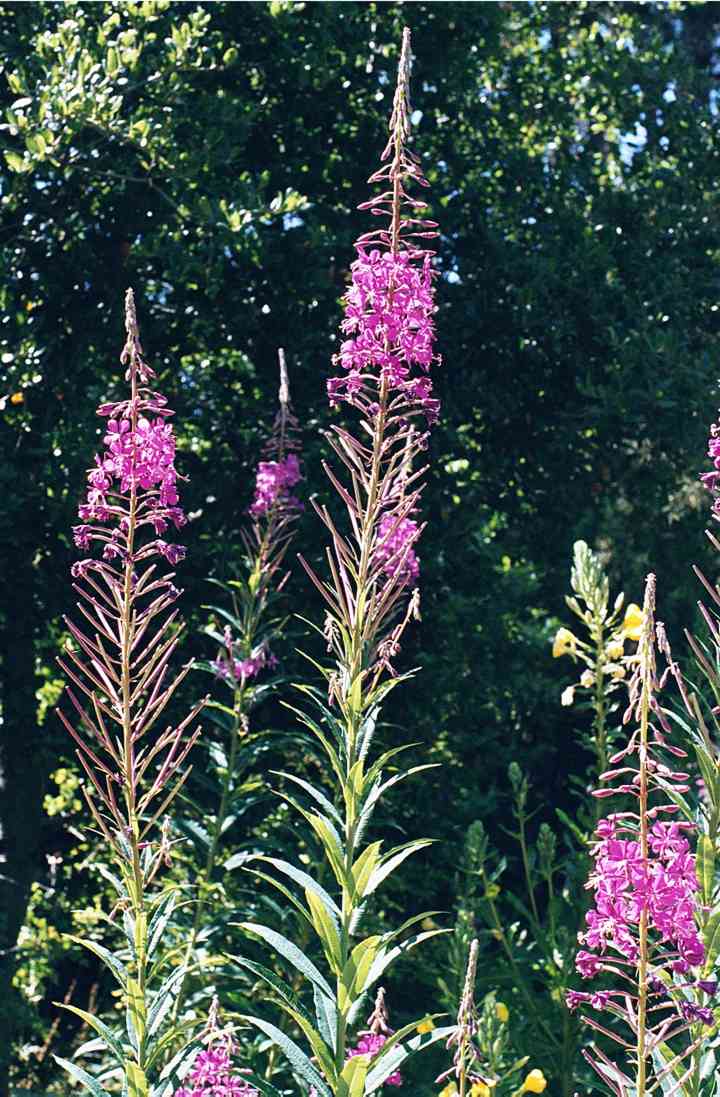
'GIANT WILLOWHERB', 'FIREWEED', 'ROSEBAY'. Large purple to rose 1 1/4" wide flowers in long showy spikes in July and August. Hardy perennial to 3 - 8 feet, with 6" willow-like leaves. N. Hemisphere. Zone 2. Good cut flower. The young shoots have been used as an asparagus. The leaves were formerly used as a tea substitute, but were said to be stupefying in excess. An ale was brewed from them in Kamchatka, with the addition of Fly Agarics. The pith of the stems was eaten by N. American Indians. The plant has many medicinal uses. "Our finest and most showy species."—Parsons.
NEW—Epilobium hirsutum. (500) EPIL-34. Packet: $2.50
'CODLINS AND CREAM', 'APPLE PIE'. Wine-red 1/2 - 1" flowers in short clusters. Hardy rhizomatous perennial to 2 - 6 feet, with downy, willow-like leaves. Eurasia, North America. Best in moist areas such as pond-side. The crushed fresh leaves have a sweet, delicate scent, hence the common names. The leaves are sucked in Russia for the salty taste. Germinates in 2 - 3 weeks warm.
EPIPACTIS
ORCHIDACEAE. Terrestrial orchids sometimes grown in the wild garden. Pretty, hardy plants that do well in pots of loam and peat.
—Epipactis Helleborine. (1000) EPIP-12. Packet: $2.50
1/10 Gram: $7.50
Click for photos »


'HELLEBORINE'. Dense spikes of purple and green 1/2" flowers in summer. Hardy perennial orchid to 3 - 4 feet. Europe, naturalized in the US. Zone 6. Sow on the surface, keep moist. One of the easiest hardy wild orchids to grow from seed.
EREMURUS (e-re-MOO-rus)
LILIACEAE. Spectacular hardy desert plants with tall flower stalks reaching 8 feet or more, often remaining in bloom for more than a month, densely clothed for half their height with starry, white, pink or yellow blossoms. Dense rosettes of strap-like basal Thrives in rich, fibrous, well-drained soil. Hardy in the North if given a thick mulch, or covered with a rain-proof box in winter. Plenty of water when blooming, keep dry afterwards. Do not hoe around them, as they have shallow, octopus-like roots. Control weeds with thick paper when dormant. Sow seed in fall to germinate in February, seedlings die down in June and reappear in late autumn. After cold treatment, they germinate in 30 days, with some stragglers taking up to a year to come up.
—Eremurus O.P. Hybrids. (25) EREM-H. Packet: $2.50
Pink and yellow open-pollinated hybrids mixed.
ERYNGIUM (e-RIN-jee-um)
UMBELLIFERAE. Attractive border and rock garden plants. Some 230 species, nearly worldwide. Somewhat thistle-like perennials valued for cut flowers and for drying. Best in full sun and light rich soil. Most germinate readily at cool temperatures, and some need cold.
—Eryngium foetidum. (50) ERYN-8. Packet: $2.50
'CULANTRO', 'FALSE CORIANDER', 'RECAO DE MONTE', 'SPIRITWEED'. Evergreen herbaceous perennial to 1 foot, with spiny toothed leaves and tiny white flowers. Tropical America. The favorite leaf to flavor soups, it is indispensable in Latin-American cooking. It has a flavor like Cilantro (Coriander) but is stronger. It has been adopted by S.E. Asian cooks. It is a highly regarded folk remedy for high blood pressure and fits. Germinates in 2 - 4 weeks, some lots dormant and need GA-3.
—Eryngium giganteum. (25) ERYN-9. Packet: $2.50
5 grams: $20.00
Click for photos »
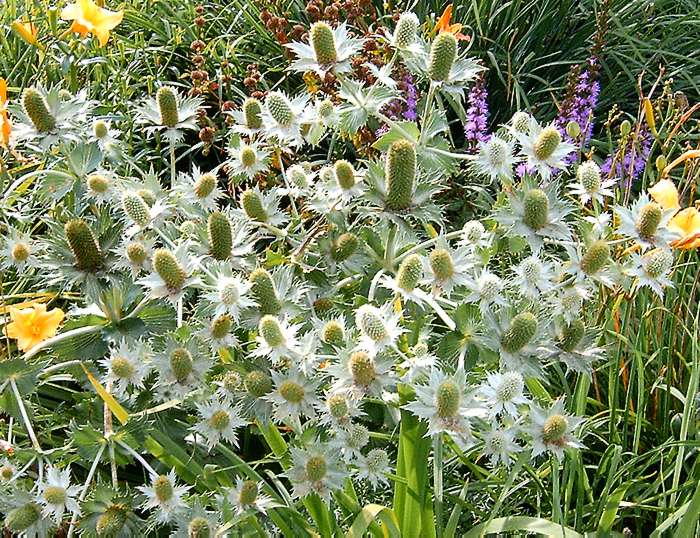
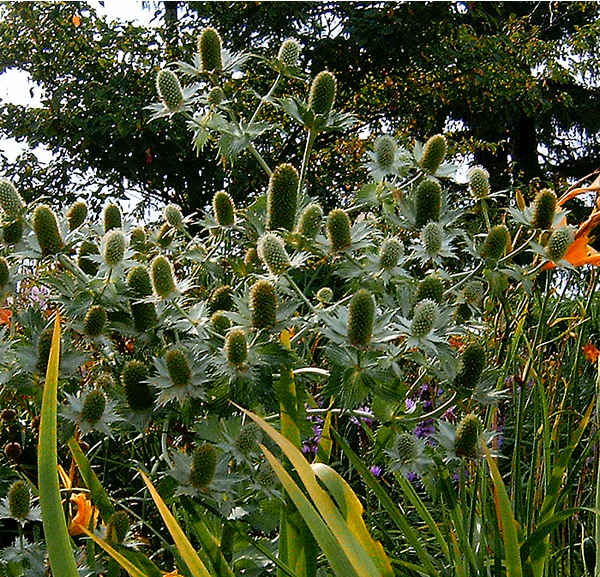

'GIANT SEA-HOLLY'. Silvery green to pale blue 4" long flower-heads with striking ivory white boldly toothed bracts. July to August. Hardy perennial to 6 feet, with triangular to heart-shaped leaves. Caucasus. Zone 4. Good, stunning, long-lasting cut flowers, which also dry well. Monocarpic; cut flowers to extend bloom. Sow in late fall, space 2 feet apart. Prechill 6 - 8 weeks to germinate in 3 - 7 months.
—Eryngium planum 'Blaukappe'. (50) ERYN-198. Packet: $2.50
'BLUE CAP'. Intense blue flowers in 1/2" heads with star-like bracts, borne profusely on a hardy perennial to 28". Eurasia. Zone 4. Germinates in 1 - 4 weeks.
"The two most common things in the universe are hydrogen and stupidity."—H. Ellison.
ERYTHRONIUM (e-ri-THRO-nee-um)
LILIACEAE. Attractive North Hemisphere cormous perennials, good in shade or the wild garden. Multi-cycle germinators.
—Erythronium oreganum. (25) ERYTH-18. Packet: $3.50
'WHITE FAWN LILY'. Large white 2" starry, nodding flowers on stalks to 1 foot, with two strap-like mottled leaves. BC to Oregon. Zone 4. Bulbs eaten by some tribes. Germination may be prolonged, try warm then cold.
—Erythronium revolutum. (25) ERYTH-21. Packet: $3.50
'PINK FAWN LILY'. Nodding, starry rose-pink flowers on stems to 16". Mottled 8" basal leaves. BC to N. California. Zone 4. Bulbs eaten by some tribes. Germination may be prolonged, try warm then cold.