MALVACEAE. Easily grown biennial and perennial herbs from the Mediterranean and Central Asia, valued for their attractive flowers. Best in a rich heavy soil and full sun, but will make a fine display almost anywhere. Nice in the back of the border, against a wall, or in a sunny corner. Germinates in about 12 days, and best sown from mid-summer to early fall for biennial plants, or early indoors for bloom the same season. The leaves of common hollyhocks are eaten cooked or in salads, especially in Egypt, and the flowers are colorful in salads.
—Alcea ficifolia Hybrids. (100) ALCE-9. Packet: $2.50
10 grams: 15.00
'FIG - LEAF' or 'ANTWERP HOLLYHOCK'. Showy single yellow, pink, red, copper and white flowers up to 4" across, in spikes to 5 feet tall. Large lobed leaves. Vigorous hardy biennial. Germinates in 1 - 2 weeks. Some lots need husking and nicking.
—Alcea rosea var. nigra. (50) ALCE-21N. Packet: $2.50
10 grams: $7.50
50 grams: $22.00
Click for photo »
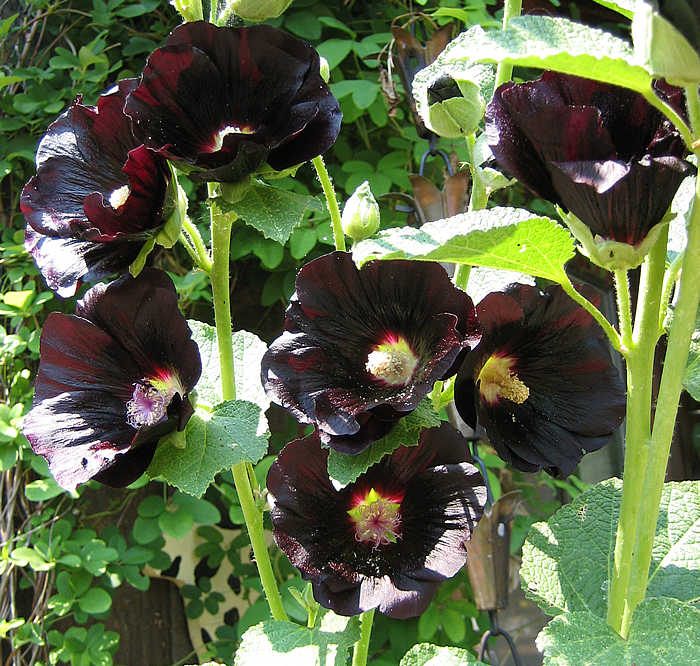
'BLACK HOLLYHOCK'. Single, deep maroon flowers shading to a glossy purple-black with glowing centers. Hardy biennial to 5 feet. A striking background plant. Germinates in 1 - 6 weeks.
—Alcea taurica. (25) ALCE-30. Packet: $2.50
5 grams: $15.00
Lemon yellow 4" flowers in summer. Hardy perennial to 5 feet, with grey-green leaves. Black Sea region. Zone 3.
ALCHEMILLA (al-ke-MIL-a)
ROSACEAE. Herbaceous plants, good groundcovers.
NEW—Alchemilla xanthochlora. (200) ALCH-96. Packet: $2.50
Gram: $10.00
'LADY'S MANTLE'. Clusters of small yellow-green flowers on a hardy perennial to 2 feet, with rounded, kidney-shaped 5" leaves. Eurasia. Zone 3. Nice mound-shaped plant.
ALLIUM (AL-ee-um)
LILIACEAE. Some 700 species of North Hemisphere bulbs and rhizomatous plants. Includes chives, garlic, onions, leeks, and many varied ornamental garden and rock garden flowers. Most are easily grown in well-drained to sandy soil and full sun.
—Allium carinatum ssp. pulchellum. (50) ALUM-19P. Packet: $2.50
'WITCHES GARLIC'. Reddish violet flowers in open graceful umbels of nodding blooms. Hardy bulb to 2 feet, blooming in summer. Europe. Zone 3. Prechill 4 weeks.
—Allium Christophii. (50) ALUM-27. Packet: $2.50
'STARS OF PERSIA'. Deep lilac 1" starry flowers with a metallic sheen, in immense 8" balls in June. To 3 feet. Persia. To Zone 4. Start seed May to August. "Probably the largest and most imposing garden species."—L.H. Bailey. Germinates in 6 - 8 weeks at cold temperatures.
NEW—Allium obliquum. (25) ALUM-63. Packet: $2.50
'TWISTED-LEAF GARLIC'. Yellowish flowers in balls, June to August. Narrow blue-green leaves. Hardy bulb to 2 - 5 feet. Eurasia. Zone 4. Cultivated since ancient times in Siberia as a garlic.
—Allium senescens. (50) ALUM-86. Packet: $2.50
'GERMAN GARLIC'. Pink flowers in 2" balls on 16" stems, abundantly produced in July and August. Hardy bulb forming clumps from rhizomes. Eurasia. Zone 4. Bulbs and leaves eaten. Short prechill helps germination.
—Allium triccocum. (20) ALUM-104. Packet: $2.50
5 Grams: $16.00
'RAMP', ' WILD LEEK'. White flowers in Summer after the leaves have faded. Hardy bulb to 1 foot, with broad blue-green leaves. NE N. America. Zone 5 or more. Leaves edible, with a leek-like flavor. Prechill seed.
—Allium tuberosum. (250) ALUM-105. Packet: $2.00
Ounce: $7.50
1/4 Pound: $20.00
Click for photo »

'GARLIC CHIVES'. Flat-leaved aromatic perennial to 20" with a garlic-like flavor. The leaves are used in Asian cookery, chopped finely like chives in various dishes. Good in wet climates where garlic tends to rot. Zone 3. Germinates in 1 - 3 weeks warm.
—Allium ursinum. (25) ALUM-115. Packet: $2.50
Gram: $7.50
5 grams: $20.00
'RAMSONS', 'BEAR GARLIC'. Starry white 1/2" flowers in umbels, and rather un-onion-like pointed, oval, 2" wide leaves. Hardy perennial to 18". Eurasia. Zone 3. The leaves and bulbs are very strongly garlic flavored, and are diced fine and added to cooking, the flavor mellowing with the heat. Seed highly dormant.
ALSTROEMERIA (al-stre-MAY-ree-a)
LILIACEAE. Showy South American perennials from tuberous roots. Attractive flowers, often spotted or streaked, are long-lasting when cut. Best in full sun or part shade in deep rich soil, or as pot plants in the North. Naturalizes well in California. The leaves twist during development, so their undersides face up. Germination may be irregular.
Click for photo

—Alstroemeria Ligtu 'Dandy Candy'. (10) ALST-15D. Packet: $4.00
Large flowers in red, rose, and picotee white with pink, with dark stripes and yellow markings. Dwarf compact plants to about 14", blooming June to October. Flowers when young. Zone 8. Give seed 3 weeks warm, then 3 weeks cold, germination irregular.
ALTHAEA (al-THAY-a)
MALVACEAE. Tall, showy, free-flowering annuals biennials and perennials grown for their attractive bloom. Easily grown in any garden soil in full sun or part shade. Many of the biennials and perennials will bloom the first year if started indoors in January or February. Sow thinly, 1/4" deep, to germinate in 9 - 12 days or more.
—Althaea officinalis. (100) ALTH-9. Packet: $2.50
Pure Seed 10 grams: $12.00
'MARSHMALLOW'. Soft pink, inch-wide flowers in clusters up the stems. Hardy perennial to 3 to 4 feet, with velvety, grey-green lobed leaves. E. Europe. Zone 3. The true Marshmallow has long been cultivated for the roots used medicinally and as food. Boiled, then fried with onions and butter, they are said to be a palatable dish, and the boiled leaves have also been eaten. Mostly they are used medicinally for coughs, inflammations, etc., 'marshmallows' originally being a medicinal candy. It is said to be an immune system stimulant. Germinates in 1 - 4 weeks.
AMARANTHUS (a-ma-RAN-thus)
AMARANTHACEAE. Easily grown annuals. Many are showy inhabitants of the flower garden, others are valuable edible grains and greens. Easy from seed sown where they are to grow, or early indoors and planted out after frost. Good in hot, dry areas and poor soil, but at their best in rich soil with plenty of moisture. Many make good cut flowers and they dry well. Wonderful old-fashioned favorites. All germinate in 1 - 2 weeks unless noted otherwise.
See Amaranth in Vegetable List for other varieties.
—Amaranthus caudatus Mira'. (1000) AMAR-1M. Packet: 2.50
5 grams: $7.50
Spectacular long 'dreadlocks' of bicolored green and rosy red flowers. Hardy annual to 4 feet. Good long-lasting cut flowers.
NEW—Amaranthus cruentus 'Autumn's Torch'. (500) AMAR-2A. Packet: $2.50
25 grams: $7.50
Large pyramidal 2 foot clusters of bronze to green flowers. Hardy annual to 4 feet. Good for cutting, long lasting. Edible seeds attract birds. Germinates in 1 - 2 weeks.
—Amaranthus hypochondriacus 'Pygmy Torch'. (1000) AMAR-20P. Packet: $2.50
10 grams: $7.50
50 grams: $10.00
'PRINCE'S FEATHER'. Red, upright spikes. To 1 foot. This species is cultivated in México for its high protein (15%) seeds, borne in large heads. The young leaves can be eaten as a potherb. Development of this plant as a food source was hindered by the attempts by the Catholic church to eradicate the plant as it figured in many important Aztec rites.
NEW—Amaranthus tricolor. (250) AMAR-42. Packet: $2.00
1/4 Ounce: $6.00
Ounce: $15.00
Click for photo »

Tall vegetable amaranth with red-veined leaves edged yellow.
—Amaranthus tricolor 'Early Splendor'. (500) AMAR-42ES. Packet: $2.50
10 grams: $10.00
Bright glowing crimson foliage. Hardy annual to 2 feet or so. Early maturity. Excellent cut-foliage for florist work, and the leaves are edible like spinach. The tender young leaves and sliced stems make a colorful addition to salads. Germinates in 1 - 4 weeks.
AMSONIA (am-SO-nee-a)
APOCYNACEAE. Hardy perennials valued in the border or among shrubbery, for their blue starry flowers. Easy in most soils in sun or part shade. Native to E. North America and E. Asia.
—Amsonia illustris. (25) AMSO-12. Packet: $2.50
Ounce: $12.00
1/4 pound: $40.00
Rich light blue flowers in early spring on a hardy perennial to 4 feet, with broad, glossy leaves. Missouri to Texas. Hardy to Zone 4 and stands gravelly to garden soil. Give 8 weeks cold, to germinate in 2 - 4 weeks.
ANAGALLIS (a-na-GAL-is)
PRIMULACEAE. Low growing annual, biennial and perennial herbs cultivated for their pretty little star- or wheel-shaped flowers in shades of red, blue and white. Free-flowering and easily grown in warm places. Good for edging borders and as pot-plants on a sunny windowsill. Sow indoors in March or outdoors in April. Germinates in 1 - 6 weeks at cool to warm temperatures.
—Anagallis arvensis. (1000) ANAG-2. Packet: $2.50
10 grams: $10.00
Click for photos »
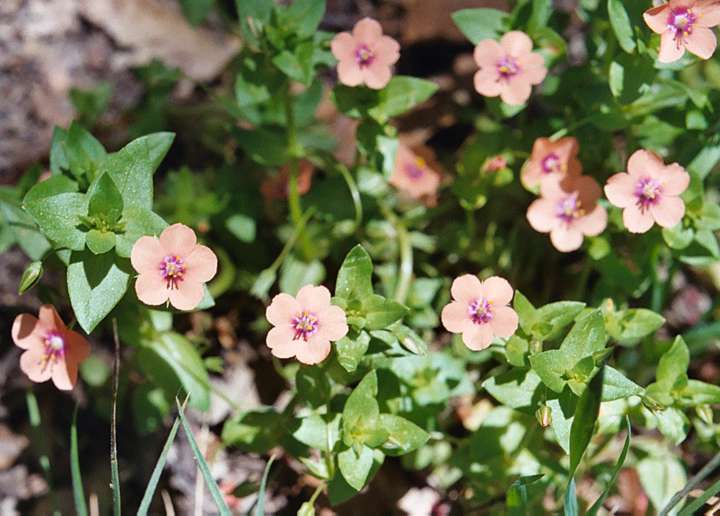
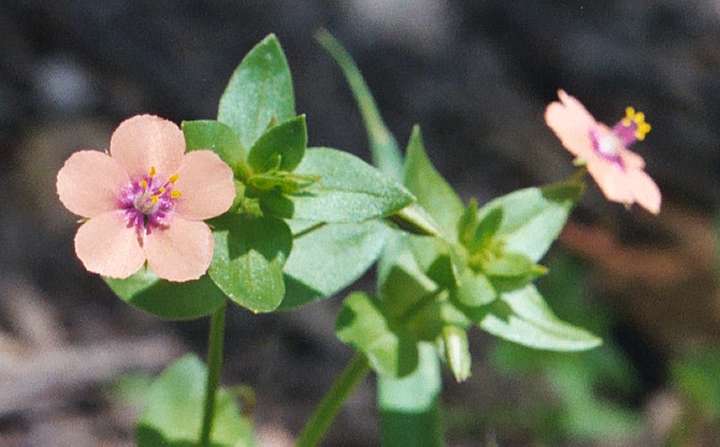
'POOR MAN'S WEATHERGLASS' 'SCARLET PIMPERNEL'. Salmon-red 5-petaled flowers produced abundantly on a low, trailing plant to 8". The petals have a purple spot at the base, and the stamens are covered with delicate violet hairs - a beautiful sight under a hand lens. The flowers close up if rain threatens. Worldwide. Formerly highly regarded medicinally, with a reputation going back to Pliny and Dioscorides. The leaves were added sparingly to salads and greens. Germinates best with light and KNO3, or GA-3, in 2 - 6 weeks. Aged seed best.
"No heart can think, no tongue can tell,
The virtues of the pimpernel."—Old Folk Rhyme.
ANDROSACAE (an-dro-SA-see)
PRIMULACEAE. Alpine tufted annuals and perennials for the rockery or low border. Pretty primrose-like flowers in clusters. Needs well-drained gritty soil but must not dry out. Likes part shade, sand, and peatmoss. Sow on surface. Seed usually germinates in 2 - 5 weeks at cool (50°F) temperatures but may hold over for a year. Try the plastic bag method and freeze for 2 weeks if slow.
—Androsace albana. (15) ANDR-4. Packet: $4.00
Tight balls of 1/3" pink flowers in spring, held above a dense rosette of 1" leaves. Hardy perennial to 4 - 6". Caucasus. Zone 4 or 6.
ANGELICA (an-JELL-i-ka)
UMBELLIFERAE. Stout aromatic perennials with stately umbels of white or pale yellow flowers. Planted in the border for ornament, food and medicine. Sow in late fall to germinate in spring, or give 4 - 6 weeks cold treatment and sow in spring.
Angelicas often do best sown outdoors as varying temperatures seem to help germination.
Bertrand reports the best success germinating the seed by sowing on the soil surface, then covering with 1/4" of chick grit, to germinate at 60 - 70°F.
—Angelica atropurpurea. (100) ANGE-4. Packet: $2.50
10 grams: $12.00
Click for photo
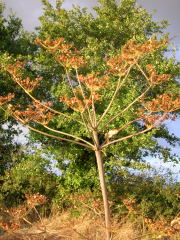
'ALEXANDERS'. Dark wine-purple stems and white flowers in 10" wide umbels. Hardy perennial to 6 feet, with divided leaves. Wet areas, eastern North America. Hardy to Zone 4. Medicinal. Prechill seed.
—Angelica lucida. (50) ANGE-17. Packet: $2.50
5 grams: $12.00
'IKUUSUK' (Iñupiaq name), 'WILD CELERY'. Large umbels of white flowers on a very hardy perennial to 2 - 5 feet, with divided aromatic leaves. Coasts, Siberia to California and New York. Zone 1? Young stems and leaf-stalks peeled and eaten raw, and the leaves cooked. Root used as an amulet against polar bears in Siberia. Many medicinal uses.
—Angelica sylvestris 'Vicar's Mead'. (50) ANGE-26V. Packet: $4.00
Gram: $15.00
Pale purple-pink flowers in large umbels, June to September. Hardy perennial to 5 feet, with reddish purple stems and bold foliage. Europe. Zone 4. Prechill seed.
"Any close and worthwhile contact with the earth tends to make one original or at least detached in one's judgments and independent of group control."—L.H. Bailey.
ANNONA (a-NO-na)
ANNONACEAE. Tropical American and African fruit trees. Grow like Citrus in California and the South. They can bear in 3 - 4 years from planting out. Some stand light frosts. Best in well-drained soil.
Annonas are easy from seed, but require warmth and may take 4 - 6 weeks or more to sprout. The seed is viable for several years in dry storage, and germination often best when seed is a year old.
—Annona muricata. (10) ANNO-16. Packet: $3.00
Ounce: $15.00 (85 seeds per ounce)
'SOURSOP', 'GUANABANA'. Largest of the genus, the 8" long, dark green fruits weigh up to 8 pounds. The sweet white flesh has been likened to black currants and perfumed cream. Evergreen tree to 20 feet, with fragrant flowers. Tropical America. The leaves are made into 'corossol tea'. Tender. Bears at an early age. The seeds are insecticidal. Has many medicinal properties. Zone 9.
—Annona squamosa. (10) ANNO-22. Packet: $2.50
Ounce: $20.00
'SUGAR APPLE', 'SWEETSOP'. Sweet yellow-green 3 - 4" fruits with lumpy skin and delicious creamy, aromatic, custard-like pulp, July to December. Small tree to 20 feet, with inch-wide flowers and narrow 5" leaves. Tropical America. Moderate to fast growth, one of the best. Powdered seed a good insecticide, and the leaves are medicinal, antibiotic, anti-cancer and contraceptive. Germinates in 3 - 40 weeks.
ANTHEMIS (AN-the-mis)
COMPOSITAE. 'CHAMOMILE'. Very free-flowering hardy aromatic annuals, biennials and perennials, with yellow or white daisy-like flowers and finely divided foliage. Grown in the border, rock or herb garden for their abundant flowers. Needs full sun, and thrives in almost any soil, a dry sandy soil being best. Sow the annuals from March to May, on the soil surface, or up to 1/4" deep for some kinds. Flowers in about 13 weeks. Biennials and perennials may be sown any time up to August. Many will self sow. Some are very good for cut flowers.
—Anthemis nobilis. (=Chamaemelum nobile) (1000) ANTH-10. Packet: $2.50
5 grams: $7.50
25 grams: $25.00
100 grams: $50.00
Click for photo »
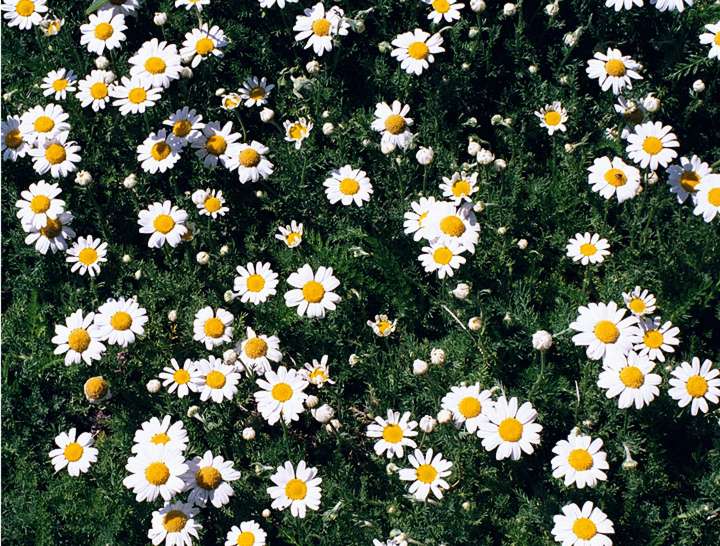
'ROMAN CHAMOMILE', 'MANZANILLA'. A hardy, low growing, compact trailing perennial to 12", with abundant white 3/4" daisies with yellow centers in July to September, held above the aromatic, finely divided, feathery foliage. Europe. Zone 4. An excellent aromatic lawn substitute; do not mow till the second year. Grown since ancient times for flavoring and medicine, the Egyptians revered its virtues and dedicated it to their gods. Chamomile tea, made from the flowers, is an old favorite, being soothing, sedative, beneficial to digestion, tonic to the nerves, and tasty, too. The whole herb was used for making herb beer. Cut flowers when fully opened for tea. Germinates in 1 - 4 weeks warm.
—Anthemis Sancti-Johannis. (100) ANTH-13. Packet: $2.50
Gram: $7.50
5 grams: $18.00
'ST. JOHN'S CHAMOMILE'. Deep orange-yellow 2" wide daisies. Hardy perennial to 2 feet, with divided leaves. Bulgaria. Zone 3. Showy and free flowering in well drained soil and full sun. Germinates in 1 - 5 weeks.
—Anthemis tinctoria 'Kelwayi'. (100) ANTH-14K. Packet: $3.00
Click for photo »
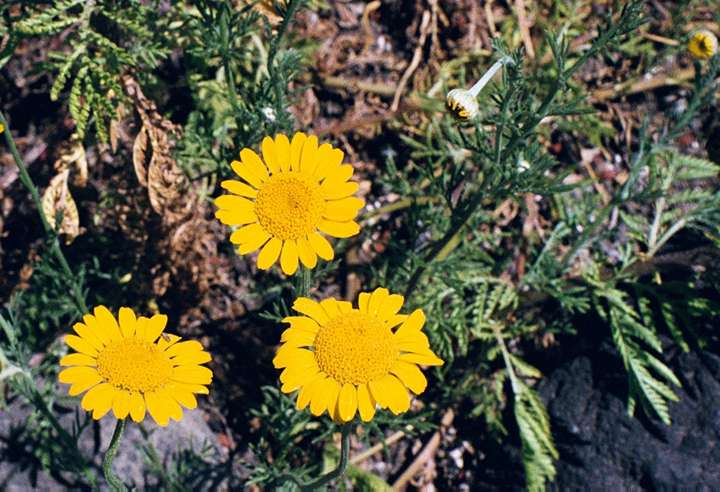
'GOLDEN MARGUERITE', 'DYER'S CHAMOMILE'. Lemon-yellow 1 1/2" daisies in summer to tall, held above finely cut feathery foliage. Hardy perennial to 16" or so. Europe. Zone 3. The flowers are used to dye wool and as a tea. "An excellent hardy perennial border plant, and useful at the same time for cut-flowers."—L.H. Bailey. Germinates in 1 - 2 weeks.
"In wine there is truth."—Pliny.
ANTHOXANTHUM (an-tho-ZAN-thum)
GRAMINEAE. Fragrant annual and perennial grasses related to Hierochlöe and Phalaris. Easily grown.
—Anthoxanthum odoratum. (250) ANOX-18. Packet: $2.50
10 grams: $7.50
50 grams: $20.00
'SWEET VERNAL GRASS'. Hardy perennial bunch grass to 2 feet, with bronzy yellow 3" spikes. Eurasia. Zone 3. Has a pleasant vanilla-coumarin scent much like Hierochlöe, and is sown in pasture to scent the lay. Soaked in brandy for a medicinal tincture. Germinates in 3 - 4 weeks at warm temperatures, light helps.
ANTIGONON (an-TIG-o-non)
POLYGONACEAE. Showy tendril climbers from México and Central America, easily grown in warm regions and in the greenhouse. Blooms best in not-too-rich soil. Vines killed by frost, but re-sprouts from the tubers. Loves heat. In the greenhouse, rest dry in winter.
—Antigonon leptopus. (10) ANTI-1. Packet: $3.00
10 grams: 7.50, 100 grams: $60.00
'CORAL VINE', 'CORALLITA'. Bright rose-pink flowers in clusters from spring to fall. Climber to 40 feet with heart-shaped to triangular leaves. México. Zone 9. "One of the handsomest summer-blooming greenhouse climbers..."—L.H. Bailey. The tubers reach 15 pounds, are edible when cooked, and are said to have a nut-like flavor. The leaves and flowers are cooked and eaten in Thailand. Germinates in 2 - 4 weeks.
ANTIRRHINUM (an-ti-RYE-num)
SCROPHULARIACEAE. Very popular annuals and perennials grown for their showy flowers which are good for cutting. Excellent in the border, and the dwarf kinds for edging and in the rock garden. The modern types are very over hybridized, but the wild kinds and old-fashioned types still retain their natural beauty. Sow seed as early as February and as late as September for winter bloom. Avoid sowing during mid-summer heat. Do not cover the seed as light is beneficial to germination, which takes 10 to 20 days, and up to 72 days for some species at cool temperatures. Seed viable for 3 - 7 years or more.
NEW—Antirrhinum braun-blanquetii. (200) ANTR-6. Packet: $2.50
Large white flowers with yellow throats. Half hardy perennial to 11/2 feet. Spain & Portugal. Good in the rockery, blooms April to Oct. Germ: 2 - 4 w.
Antirrhinum majus maximum Varieties:
'SNAPDRAGONS'. These are the old-fashioned open pollinated tall snapdragons, cottage-garden favorites. Easily grown, excellent for cut flowers.
—Antirrhinum majus 'Appleblossom'. (1000) ANTR-30AP. Packet: $2.50
25 grams: $7.50
100 grams: $25.00
Appleblossom pink and white flowers in spikes to 2 - 3 feet tall. Germinates in 1 - 2 weeks.
—Antirrhinum majus 'Bizarre Mix'. (1000) ANTR-30BX. Packet: $2.50
5 grams: $9.00
25 grams: $20.00
100 grams: $60.00
Unusual speckled, striped, and mottled flowers in a variety of shades. Long blooming, to 20" tall. Germinates in 1 - 2 weeks. "Wrote some time ago about how your Bizarre snap dragon over wintered here in Zone 6 Indiana. Have had a couple of nights of 22°F and still to date 14 December have a few blossoms opening on them. Do expect it to over winter and bloom thru 2022."—Allan Meisner.
—Antirrhinum majus 'Black Prince'. (1000) ANTR-30P. Packet: $2.50
25 grams: $7.50
100 grams: $25.00
Deep crimson flowers above foliage that darkens to bronzy-purple in cold weather. Semi-dwarf to 18". An old classic, introduced a hundred years ago.
NEW—Antirrhinum majus nanum 'Circus Clowns'. (1000) ANTR-30CC. Packet: $2.50
25 grams: $7.50
100 grams: $25.00
Large spikes of bicolored blooms in white, yellow, orange, lavender, and red. To 18" or so.
—Antirrhinum majus 'Twilight Mix'. (1000) ANTR-30T. Packet: $2.50
10 grams: $7.50
100 grams: $50.00
Nice mix of colors, rose, white, yellow, lavender, and bicolors. Semi-dwarf plants to a foot or so, with dark bronzy leaves.
NEW —Antirrhinum majus ssp. majus. (250) ANTR-30M. Packet: $2.50
Gram: $9.00
'WILD SNAPDRAGON'. Purple-rose flowers in June to September, on a half-hardy perennial to 30" or so. This is the original wild form of the cultivated snapdragon. Germinates in 2 - 4 weeks.