Many items listed here came in late, so were deleted from the main catalog to save space. Yes, an item listed in the print edition failed germination test, so is out of stock from day one! These things happen...
"United we stand, divided we fall."—Aesop, ancient Greece, 620-564 BCE.
"And if a house be divided against itself, that house cannot stand."—Mark 3:25.
"No doubt that the free interchange of seeds between seed-merchants and customers is one of the most fertile causes of the enormous increase in varieties in recent times."—L.H. Bailey, 1906.


2026 Spring Supplement Seedlist - A - C
ABRONIA (a-BRO-nee-a)
NYCTAGINACEAE. North American sand-loving plants grown for their attractive heads of fragrant flowers. Seed germinates best when husk removed, easiest by rubbing through a screen or sieve. Best in light sandy soil.
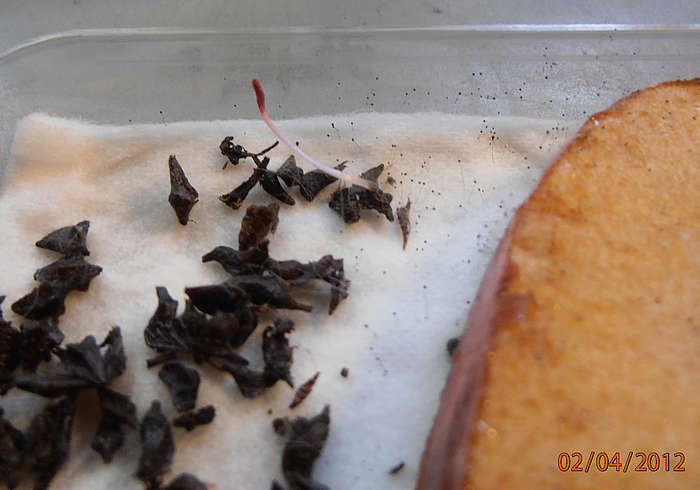
Rub tiny black seed out of husk, then germinate on a paper towel on a covered plate with slices of ripe apple to produce ethylene to germinate in 1 - 8 weeks. Change the apple slices whenever they start to get moldy. Almost every time you put fresh apple in, you will get more sprouts in a few days. Keep doing this even if you don't get sprouts for a couple of changes of apple - more will sprout later. It really works! If you leave them in the husk, just soak overnight and germinate with the apple slice as usual, but this gives lower germination. You can scatter the seed on the surface of the soil in a pot, add the apple slices, and cover with plastic wrap to hold the ethylene. Or give 8 weeks prechill, or sow in fall. Worth the effort! Most species have a percentage of empty husks. Some photos of the process:
Put the unrubbed seed in a sieve:
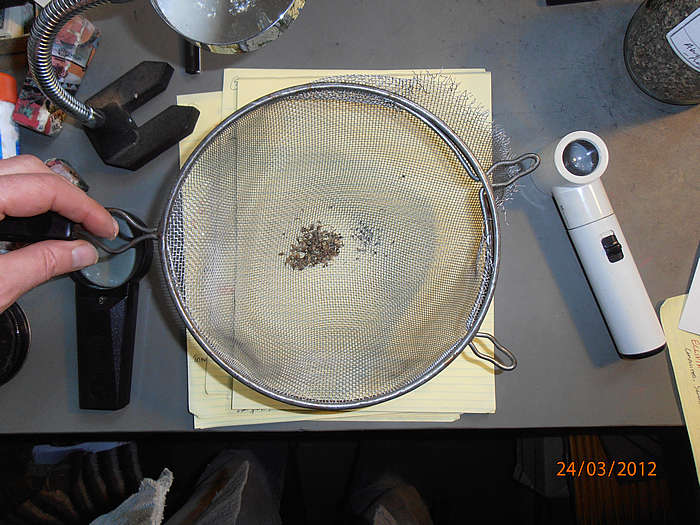
Rub the seed through the sieve - the husks are tough! Or you can peel the individual husks in species with large husks.
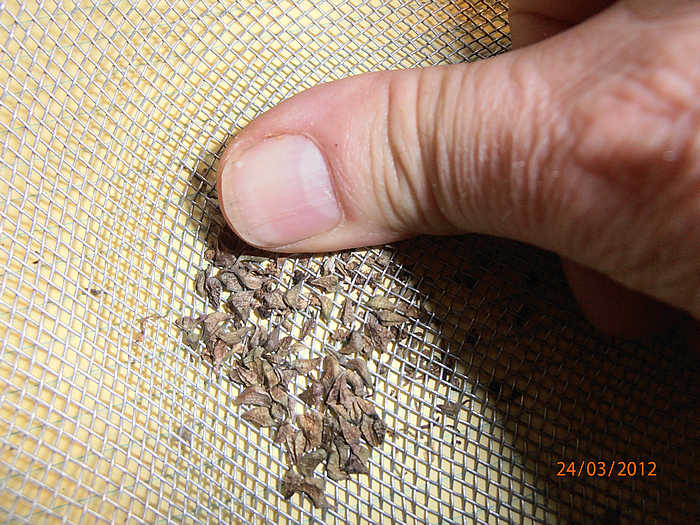
The cleaned seed is small, black, and shiny:
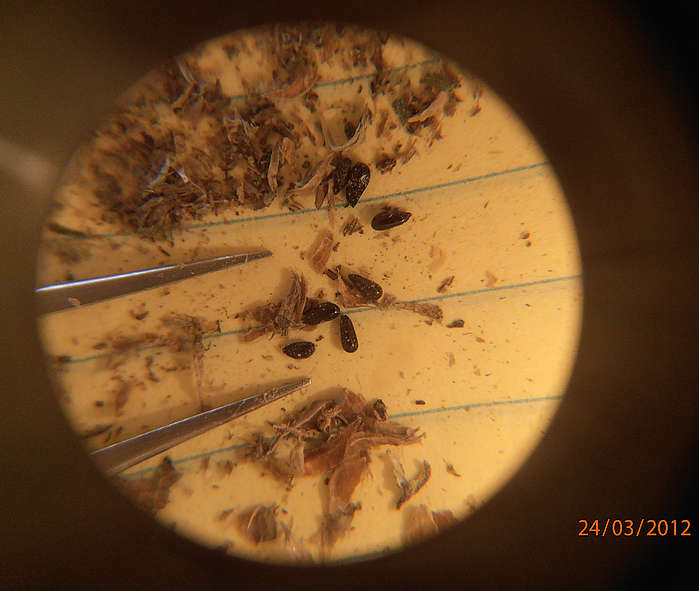
Cleaned seed placed on a damp pad with a slice of ripe apple, March 24th, 2012:
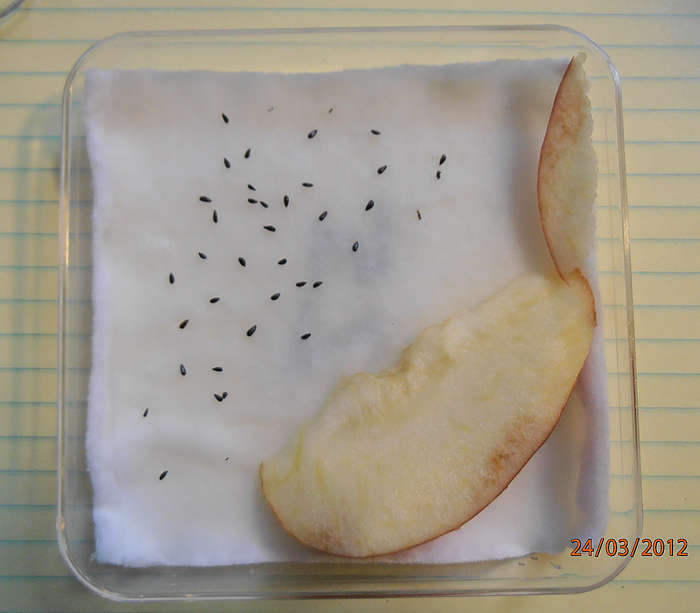
Two tests - one of rubbed seed, one unrubbed, both covered:
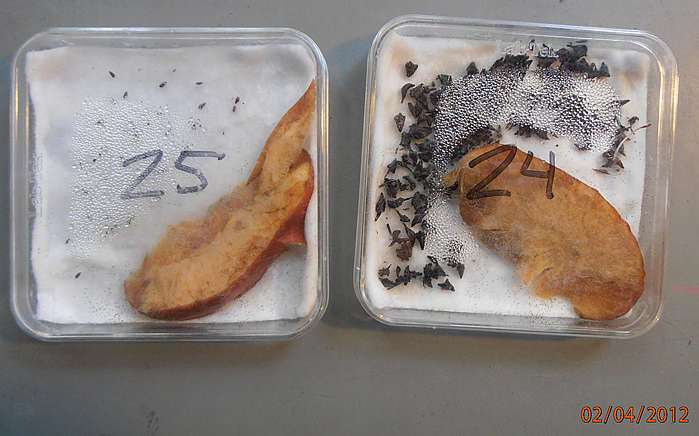
Sprouts on April 2nd:
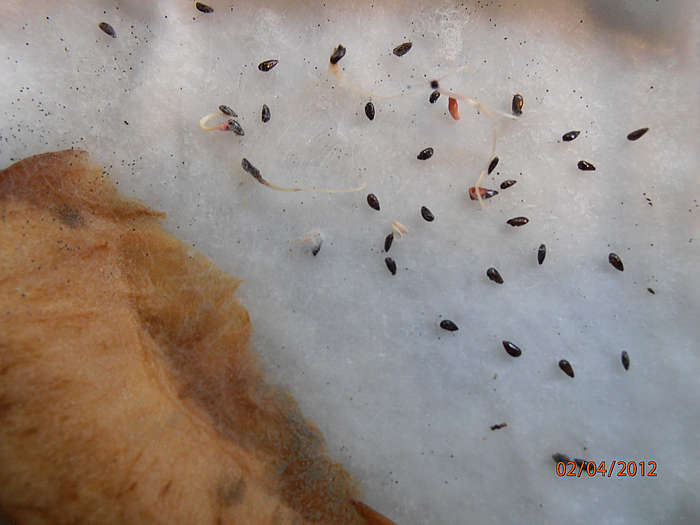
Unrubbed seed will sprout, but gives lower germination:
Rubbed seed in a pot with apple slices:
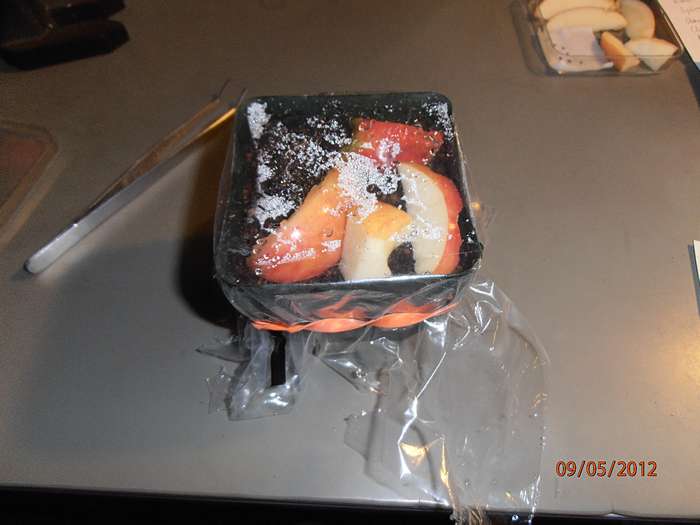
Sprouting in a pot:
—Abronia latifolia. ABRO-15. Packet: $2.50
https://calscape.org/Abronia-latifolia-(Sand-Verbena) Nice photo and information.
'YELLOW SAND VERBENA'. Bright yellow flowers in dense balls above somewhat succulent round leaves. Sprawling perennial from west coast beaches. Almost ever-blooming. The large roots were eaten by coastal Indians, compared to sugar beets. Best in deep sandy soil.
ACACIA
—Acacia crassicarpa. (10 ACAC-27. Packet: $2.50
https://apps.lucidcentral.org/wattle/text/entities/acacia_crassicarpa.htm Photos and information.
https://apps.worldagroforestry.org/treedb2/speciesprofile.php?Spid=28 Photos and agroforestry information.
https://worldwidewattle.com/imagegallery/image.php?p=0&l=c&id=20604&o=11 Image gallery.
https://profiles.ala.org.au/opus/foa/profile/Acacia%20crassicarpa Detailed information and lots of photos.
https://images.ala.org.au/image/details?imageId=5e83e256-cbfb-47a4-bad1-999eba2168fe Beautiful image.
'NORTHERN GOLDEN WATTLE', 'WOODY POD WATTLE'. Spikes of golden yellow flowers on a tree to 20 - 80 feet, with greyish phyllodes. N. W. Australia. Zone 9 or 10. Vigorous and long lived. One of the fastest growing, used in agroforestry.
—Acacia denticulosa. (10) ACAC-34. Packet: $2.50
https://worldwidewattle.com/imagegallery/image.php?p=0&l=d&id=3293&o=1 Good images.
https://apps.lucidcentral.org/wattle/text/entities/acacia_denticulosa.htm Good images and info.
https://www.anbg.gov.au/gnp/interns-2012/acacia-denticulosa.html Good cultivation info.
'SANDPAPER WATTLE'. Unique species with spikes of bright yellow flowers and odd round phyllodes with a rough texture. Shrub to 3 - 12 feet. Rare species from western Australia, considered threatened. Hardy down to about 18°F. One of the most unusual and striking species.
ACHYRANTHES (a-kee-RAN-theez)
AMARANTHACEAE. Warm region plants related to Alternanthera and Iresine. Little known here.
—Achyranthes bidentata. (100) ACHY-6. Packet: $2.50
'NIU-XI', 'OX-KNEE'. Slender spikes of small flowers and broad oval leaves and large greenish-purple stems with joints resembling an ox's knee. China. Used in Chinese medicine as a 'blood invigorator' and has effects on the uterus, and is used during labor. Germinates in 1 to 2 weeks
ADONIS (a-DOH-nis)
RANUNCULACEAE. 'PHEASANT'S EYE'. Hardy annuals and perennials grown in the border or rock garden for their showy, solitary crimson to yellow flowers and attractive, finely divided foliage. Easily grown in both sun and part shade, preferring a deep, rich soil. Space 6 - 8". Easy from seed, which may be slow and erratic. Both annuals and perennials may be sown in fall or early spring, barely covered, to germinate in 14 days to 4 months at cool temperatures. Annuals may flower in 14 weeks.
—Adonis aestivalis. (25) ADON-1. Packet: $2.50
'FLOS ADONIS', 'PHEASANT'S EYE'. Brilliant crimson 1 1/2" flowers held above the feathery foliage. Hardy annual to 18", blooming freely in June and July. A most attractive plant from Central Europe. Cultivated since 1629.
AETHIONEMA (eh-thee-o-NEE-m a)
CRUCIFERAE. Mediterranean and Asian annuals and perennials grown for their abundant bloom.
—Aethionema grandiflorum. (50) AETH-11. Packet: $2.50
'PERSIAN STONE CRESS'. Bright pink flowers cover the plant in summer. Hardy perennial to 12", with narrow leaves. Iran. Zone 5 or 7. Good rock garden plant. Cool temperatures to germinate.
AGAVE (ah-GA-vee)
AGAVACEAE or LILIACEAE. 'CENTURY PLANT'. Striking, mostly arid-region plants with dramatic rosettes of sword-shaped, succulent leaves. They range from tiny rosettes less than a foot wide, to gigantic species 20 feet wide, sending flower-spikes 40 feet into the air. Various species provide food - roasted hearts, leaves and nectar; fiber - henequen, sisal, and paper; drink - fermented juice for pulque and distilled for mescal. They provide thorns for needles, thatching, smoking and other uses. Easily grown outdoors in mild climates or in pots in the North. Set outdoors in summer. Best in a well-drained sandy loam and full sun. Sow on the surface to germinate in a few weeks to 3 months or so.
—Agave Parryi. (25) AGAV-192. Packet: $2.50
Click for photo »
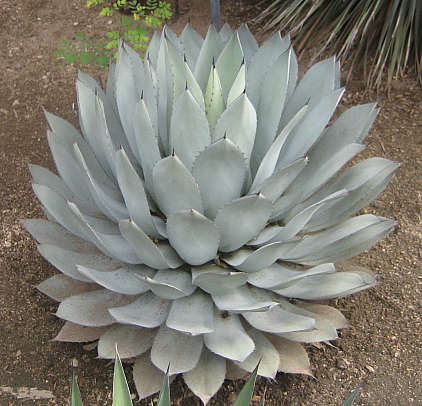
'MESCAL'. Small rosettes of 10 - 16" grey- or blue-green, sword-shaped, 4" wide leaves with spines along the edge and tip. Bright yellow 1 1/4" flowers from red buds, in 5 - 8 foot long clusters on stalks to 10 - 15 feet tall. Arizona to México. One of the hardiest agaves, Zone 7. The hearts were roasted in pits for mescal, a staple food of the Indians. Roasted flower-stalks eaten, and the leaves produce fiber. Germinates in 1 - 2 weeks warm.
AGONIS (A-go-nis or a-GO-nis)
MYRTACEAE. 'WILLOW MYRTLE'. Handsome, drought-resistant West Australian trees. Fast growing and noted for tolerating severe arid conditions if given a few deep waterings while establishing. Smoke treatment may help germination.
—Agonis flexuosa. (100) AGON-2. Packet: $2.50
https://anpsa.org.au/plant_profiles/agonis-flexuosa/ Good description and flower photo.
https://florabase.dpaw.wa.gov.au/browse/profile/5316 Nice photos and information.
'PEPPERMINT WILLOW MYRTLE'. Striking weeping tree to 25 - 35 feet, densely clothed with narrow, willow-like, bronze-edged 6" leaves, which are a rich pink in spring. Abundant, scented small white flowers in spring. W. Australia. The foliage is strongly peppermint-scented when crushed. Quickly forms a nice single-trunked tree resembling a weeping willow. Tolerant of a variety of soils, good in limestone areas. Easy in tubs, sun or semi-shade. Freezes to the ground at 25°F, but can stump sprout. "One of the best small trees for California gardens where temperatures stay above 27°F."—Sunset. Germinates in 2 - 28 weeks at warm temperatures.
AGRIMONIA (ag-ri-MO-nee-a)
—Agrimonia pilosa. (50) AGRI-18. Packet: $2.50
https://www.sciencedirect.com/science/article/pii/S2405844022012609 Review of medicinal use scientific papers.
https://pmc.ncbi.nlm.nih.gov/articles/PMC9076299/ Review of medicinal use scientific papers.
'CHINESE AGRIMONY', 'XIAN HE CAO', (means 'immortal crane herb') Yellow flowers in long spikes. Hardy perennial to 4 feet, with divided leaves. Eurasia. Zone 1. Used in traditional Chinese medicine as a tonic, for blood conditions, ulcers, gastrointestinal bleeding, and parasites.
ALBIZZIA (al-BIZ-ee-a)
LEGUMINOSAE. Trees or shrubs closely related to Acacia and Mimosa, with graceful feathery foliage and pink, yellow, or white plume-like flowers. In the greenhouse, repot in March. May be grown as annuals for their foliage in summer flower beds. Easy from seed.
—Albizzia Julibrissin. (50) ALBI-1. Packet: $2.50
Ounce: $9.00
1/4 lb: $20.00
Click for photo »
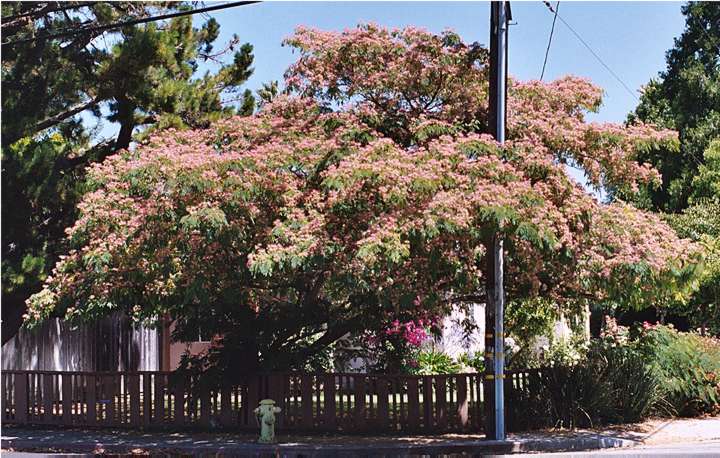
'SILK TREE', 'MIMOSA', 'HE-HUAN'. Showy pink puff-like flowers in summer. Round-headed tree to 40 feet, with feathery dark green foliage which folds up at night. Iran to Japan. Fairly hardy, Zone 6 - 7. Likes heat. Considered an auspicious tree, "promoting agreement and affection". The young leaves have been eaten or used for tea, and the flowers dried or candied. Bark used in Chinese medicine as a tonic "promoting joy, assuaging sorrow, brightening the eye, and giving the desires of the heart." Nick and soak to germinate in 1 - 3 weeks.
ALEURITES (al-u-REE-teez)
EUPHORBIACEAE. Asian and Pacific Island trees.
—Aleurites moluccana. (5) ALEU-4. Packet: $3.50
50 seed: $25.00 (Shipping weight 20 ounces)
Click for photos »
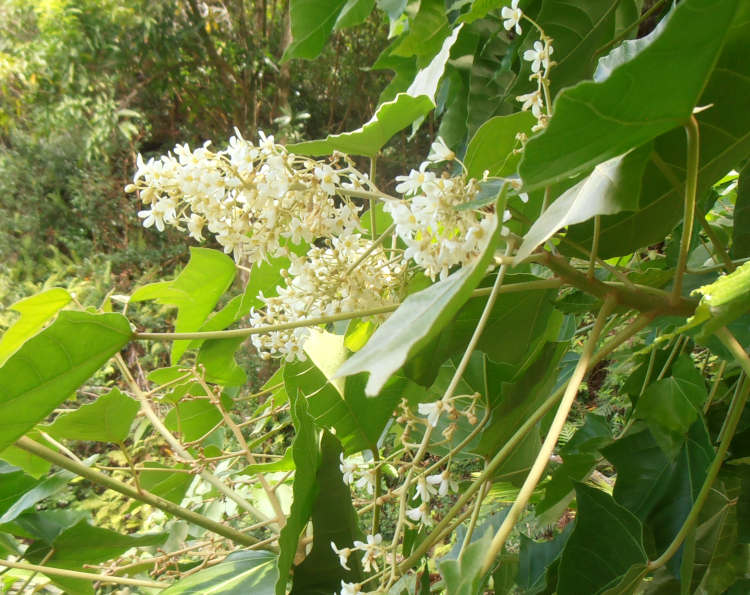
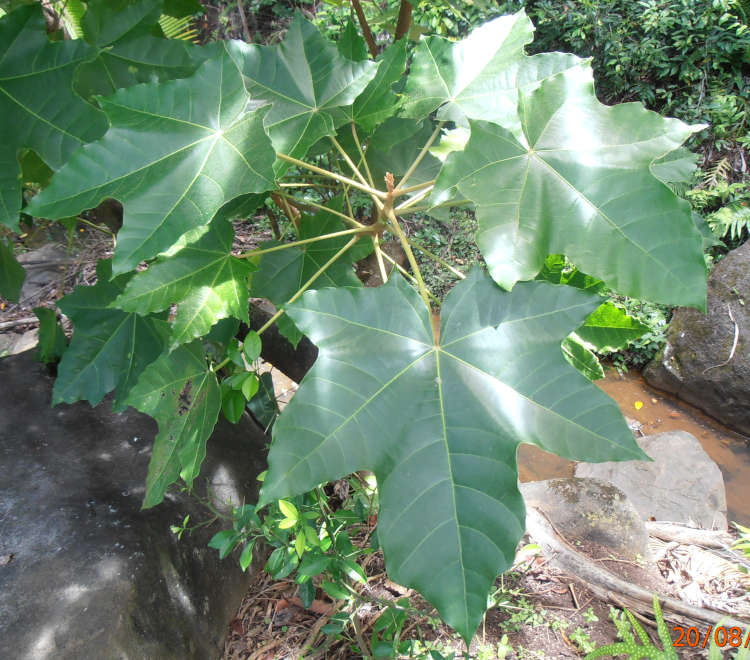
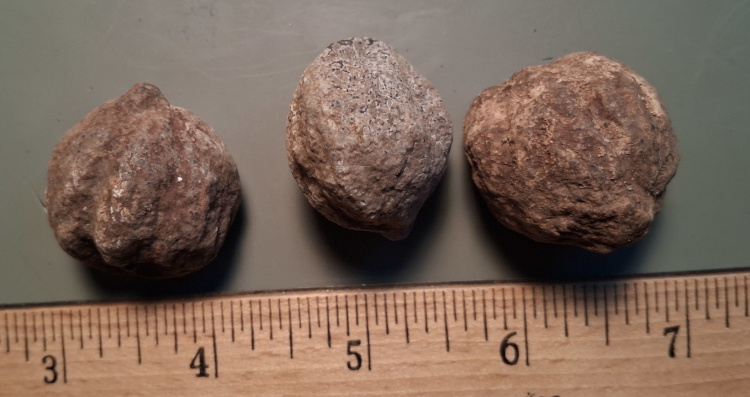
'KUKUI NUT', 'CANDLE NUT'. Small white flowers in 10" clusters. followed by clusters of green 2" fruits resembling walnuts. Handsome tree to 80 feet, with large 8" leaves. SE Asia and Pacific islands. Zone 10. The official emblem of Hawaii because of its many uses. The nuts contain 50% oil, used by the old Hawaiians in lamps for light, and the nuts are polished and strung in leis. Needs nicking, but germinates best after burning a layer of straw on the nuts, then dousing with cold water.
ALOE (AL-o-ay or AL-o)
LILIACEAE. Popular perennial succulents with rosettes of spiny-toothed sword-shaped leaves and showy tubular flowers. Grown in the greenhouse loam in full sun. Some species are valuable medicinal plants, their juice being dried and used as a purgative, or fresh as topical treatment of wounds and burns, including X-ray and radiation burns, promoting cell growth and speeding the healing process. All are CITES (Convention on International Trade in Endangered Species) endangered species. Germinates easily.
—Aloe ferox. (25) ALOE-127. Packet: $2.50
Scarlet-orange to greenish yellow 1 1/2" flowers in 4 foot spikes. To 9 - 15 feet, with leaves 2 1/2 feet long, 6" wide, with purplish edges and yellow teeth. South Africa. This is the most important source of the valuable medicine 'Cape Aloes', consisting of the dried leaf-juice, used as a purgative. Germinates in 1 - 2 weeks.
ALYOGYNE (al-ee-O-ji-nee)
MALVACEAE. Showy-flowered Australian shrubs and small trees with palmately divided leaves. Excellent ornamentals for warm areas and in the greenhouse, becoming increasingly appreciated in California. Easily grown from seed.
—Alyogyne hakeifolia. (25) ALYO-9. Packet: $2.50
Covered from spring to summer with large 3" pale purple-lilac flowers with crimson throats. The leaves are divided into narrow, thread-like segments. Dark green shrub to 5 - 10 feet. W. Australia. A beautiful shrub for warm, dry areas. Lightly nick seed to germinate in 1 - 6 weeks.
—Alyogyne Huegelii. (25) ALYO-11. Packet: $2.50
'BLUE HIBISCUS'. Beautiful lilac-blue flowers up to 4 - 5" across, the petals with a glossy sheen. Blooms off and on throughout the year. Deeply lobed dark green leaves. Evergreen shrub to 5 - 8 feet. Australia. Likes a warm, dry position. Hardy to about 27°F. One of the prettiest little shrubs. Lightly nick seed. Germinates in 2 - 12 weeks.
ALYSSOIDES (al-iss-EE-deez)
CRUCIFERAE. Alyssum-like Eurasian perennials.
—Alyssoides utriculata. (25) ALYD-6. Packet: $2.50
Brilliant yellow 1 1/2" wide flowers in dense clusters in May and June, followed by inflated 1/2" pods. Hardy perennial to 8 - 18". Alps to Turkey. Good in the rock garden, and the pods for dry arrangements. Germinates in 2 - 6 weeks warm.
ALYSSUM
CRUCIFERAE. Eurasian herbaceous plants grown in the rock garden or border. Best in full sun and poor dry rocky soil. Some bioaccumulate nickel.
—Alyssum repens. (75) ALYS-24. Packet: $2.50
'CREEPING MADWORT'. Bright yellow-orange flowers cover the plant in May and June. Hardy mounding perennial to 20". Eastern Europe to Iran. Zone 6. Germinates in 4 - 6 weeks.
AOTUS (a-O-tus)
LEGUMINOSAE. Beautiful small Australian shrubs.
—Aotus ericoides. (50) AOTU-7. Packet: $2.50
https://resources.austplants.com.au/plant/aotus-ericoides/ Nice photo and cultivation info.
https://www.oznativeplants.com/plantdetail/Common-Aotus/Aotus/ericoides/zz.html Nice photo.
'GOLDEN PEA'. Abundant bright golden yellow flowers marked red. Shrub to 6 feet, with narrow inch-long leaves. S.E. Australia. Best in sandy, well-drained soil. Hot water soak to germinate.
ARENARIA (ah-re-NAR-ee-a)
CARYOPHYLLACEAE. 'SANDWORT'. Low growing often mat-forming annuals and perennials. Good in the rock garden and as carpet bedding. Best in sandy soil. Start in April or May, will germinate in 2 - 3 weeks at cool temperatures.
—Arenaria serpyllifolia. (1000) AREN-40. Packet: $2.50
https://www.researchgate.net/publication/349683492_Arenaria_serpyllifolia_L_A_review_of_medicinal_uses_phytochemistry_and_pharmacology Nice photos, chemistry.
https://pfaf.org/user/Plant.aspx?LatinName=Arenaria+serpyllifolia Uses.
'THYME-LEAVED SANDWORT'. Small starry flowers in summer on a sprawling annual or biennial to 4 - 12", with tiny leaves. Central Eurasia. used medicinally for kidney function, dysentery, and to improve eyesight, and eaten as potherb.
ARISAEMA
—Arisaema consanguineum. (10) ARIS-5. Packet: $2.50
Spathes green striped deep purple & white inside, to 7" long, in early summer. Large divided leaves on 3 foot tall mottled stalks. Himalayas.
ARISTOLOCHIA
—Aristolochia Clematitis. (10) ARST-4. Packet: $3.00
'BIRTHWORT'. Clustered bright yellow oddly shaped 1 1/2" flowers from May to July. Upright hardy perennial to 1 - 3 feet, with heart-shaped leaves. S. Europe. An old medicinal plant, known to the ancient Greeks, long used as an emmenagogue, to aid childbirth, and as snakebite antidote. GA-3 helps
ARNICA
—Arnica Parryi. (50) ARNI-19. Packet: $3.50
'NODDING ARNICA'. Nodding yellow petalless flowers in late summer. Hardy perennial to 12 - 20", with long basal leaves. Western North America, Yukon to Colorado. Zone 2?
ARTEMISIA
—Artemisia californica. ARTE-10. Packet: $2.50
'COAST SAGEBRUSH', 'OLD MAN'. Fragrant grey shrub to 1 - 5 feet, with finely divided thread-like leaves and long panicles of tiny, nodding flowers in July to Sept. Common on exposed dry rocky slopes of coastal California. The fragrant foliage was a highly valued medicine among the Indians and Spanish Californians. Early miners used the branches as a flea repellent. When burned or placed on coals, they give a fragrant smoke. Germinates in 1 - 2 weeks.
ASCLEPIAS
—Asclepias physocarpa (=Gomphocarpus p.) (50) ASCL-9. Packet: $2.50
5 grams: $7.50
'SWAN PLANT', 'HAIRY BALLS'. Creamy white 1/2" flowers in clusters in spring and summer, followed by curious inflated pods which are floated on water by children in South Africa to resemble baby swans. Shrubby perennial to 6 feet, with narrow leaves. S. Africa to India. Zone 7. Can be grown as an annual. Germinates in 3 - 4 weeks.
—Asclepias subverticillata. 50) ASCL-47. Packet: $2.50
https://www.npsnm.org/wildflowersnm/Asclepias_subverticillata.html Lots of nice photos.
'HORSETAIL MILKWEED'. Large clusters of white flowers in May to September. Hardy perennial to 40", with long narrow leaves. Wyoming to Chihuahua. Good monarch host plant for the arid West.
ASTARTEA (as-TAR-tee-a)
MYRTACEAE. Lovely Australian flowering shrubs.
—Astartea fascicularis. (1000) ASTT-10. Packet: $2.50
https://www.anbg.gov.au/gnp/gnp2/astartea-fascicularis.html Photos, description, and cultivation.
Small white or pinkish five-petaled flowers borne abundantly on a small graceful shrub to 3 feet tall. West Australian endemic. Stands some frost. Germinates in 4 - 8 weeks.
ASYNEUMA (a-see-NOO-ma)
CAMPANULACEAE. Eurasian perennials related to Phyteuma, with flowers in shades of blue and violet.
—Asyneuma canescens. (75) ASYN-12. Packet: $4.00
Blue-violet to pale lilac 1/3" flowers in branched spikes, June to August. Hardy perennial to 3 feet, with greyish downy foliage. S. Europe to Greece. Germinates in 1 - 3 weeks.
BACKHOUSIA (back-HOW-see-a)
MYRTACEAE. Subtropical evergreen aromatic Australian rainforest trees and shrubs. For mild climates.
—Backhousia citriodora. (25) BACK-6. Packet: $2.50
Click for photo » Flowers
'LEMON-SCENTED MYRTLE'. Small white flowers in dense clusters in summer. They are strongly lemon-scented. Small tree to 25 feet, with leathery 4" lemon-scented leaves. N. Australia. Zone 9. It has a true delicious lemon scent and is grown for food flavoring. Sow the individual pods on sandy soil and keep evenly moist to germinate in 5 - 12 weeks.
BAECKEA (BAY-kay-a)
MYRTACEAE. Small, free flowering often heath-like shrubs from Australia, Asia and the South Pacific. Easily grown in warm regions or in the cool greenhouse, hut are little-known. Some are used for tea.
—Baeckea virgata. (=Babingtonia pluriflora) (1000) BAEC-25. Packet: $2.50
'TALL HEATH-MYRTLE'. Tiny white-petaled star-like flowers held out from the twigs. Nice shrub to 12 feet, with soft, narrow, inch-long leaves which are scented when crushed. E. Australia. Good hedge or windbreak, and good in tubs. Good cut flowers as they are honey-scented. Zone 9. Germinates in 2 - 3 weeks.
BRACHYCHITON (bra-kee-KI-ton)
STERCULIACEAE. Australian trees with swollen trunks. Grown in warm regions for their masses of showy flowers.
—Brachychiton populneus. (10) BRAC-19. Packet: $2.50
50 seeds: $7.50
Click for photo »
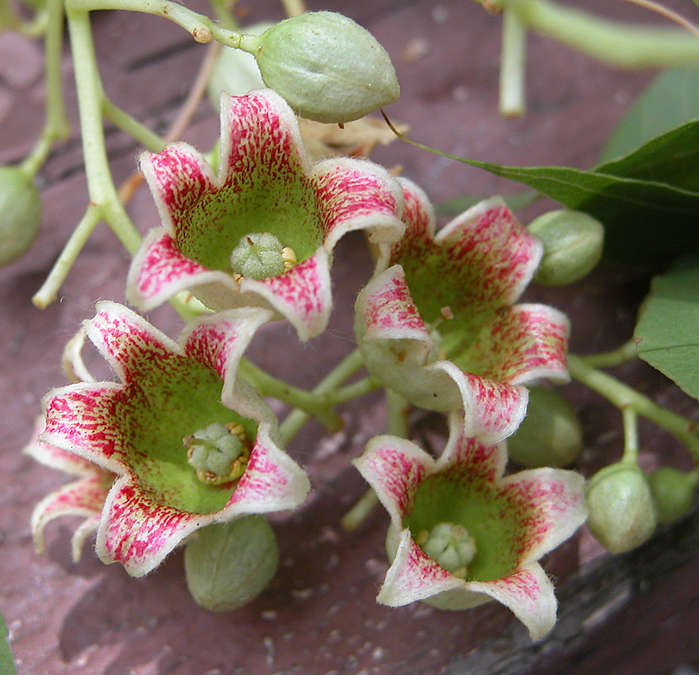
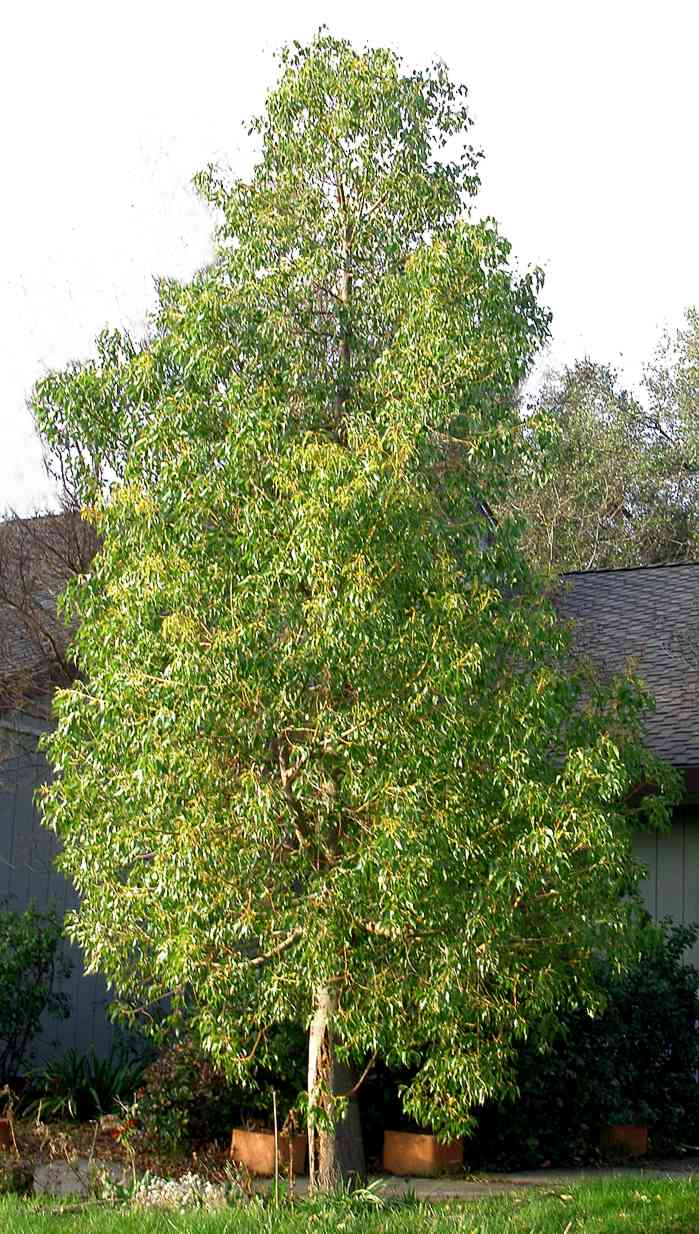
'BOTTLE-TREE', 'KURRAJONG'. Bell-shaped white flowers in clusters in May and June. Evergreen tree to 60 feet, with swollen, bottle-shaped trunk and dense, pale green 3" leaves. Australia. Zone 8. Good shade tree in the low desert. Soak overnight, rub off covering, to germinate in 1 - 3 months.
BROMUS (BRO-mus)
GRAMINEAE. About 150 species of grasses, including many ornamentals & important forage species. Easily grown annuals and perennials. Seed half-life is about 3 - 5 years.
—Bromus vulgaris. (100) BROM-140. Packet: $2.50
Graceful nodding clusters of inch-long spikelets on slender stems. Perennial to 3 - 4 feet, forming small clumps. Dry woods and moist shady places, Western North America. A nice graceful native.
CALENDULA
—Calendula arvensis. (100) CALN-4. Packet: $2.50
10 grams: $10.00
'FIELD MARIGOLD'. Small golden flowers a quarter the size of C. officinalis. Attractive little annual usually only a few inches tall, larger in cultivation. Mediterranean. Best in poor dry soil. Good for naturalizing. Seed heads interesting, bearing 3 distinct shapes of seed. Used medicinally in Provence. The leaves have been used as a pot herb, and the flowerheads pickled.
CALLIRHOE (ka-LEE-ro-ay)
MALVACEAE. Hardy N. American annuals and perennials grown for their profusion of showy flowers and attractive foliage. Easily grown in sunny areas and thriving in poor dry soils, giving a long period of summer bloom. Sow in early spring to germinate in about 3 weeks. They "...are of easiest culture, and deserving of much greater popularity."—Taylor.
—Callirhoe involucrata. (25) CAL-20. Packet: $4.00
'WINE CUPS', 'POPPY MALLOW'. Bright red 1 1/2" wide flowers produced in profusion. Hardy trailing perennial to 1 foot or so, with deeply divided leaves. N. Dakota to Texas. Good in dry soil. The sweet starchy roots are cooked and eaten, and the leaves used to thicken soups. For best germination, give a hot water soak, then rub husks off, to germinate in 1 - 4 weeks. Well worth the effort!
CALLUNA (ka-LOO-na)
ERICACEAE. A single species.
—Calluna vulgaris. (1000) CALL-1. Packet: $2.50
'SCOTCH HEATHER'. Purple-pink flowers in long dense 10" racemes. Hardy shrub to 3 feet, with scale-like leaves. Blooms abundantly in late summer. Germinates with GA-3 or prechill.
CALOCHORTUS
—Calochortus flexuosus. (25) CALOC-24. Packet: $2.50
https://www.americansouthwest.net/plants/wildflowers/calochortus-flexuosus.html Beautiful photos.
https://calphotos.berkeley.edu/cgi/img_query?query_src=ucjeps&where-genre=Plant&where-taxon=Calochortus%20flexuosus&title_tag=Calochortus%20flexuosus Many beautiful photos.
'WINDING MARIPOSA LILY'. Large pink to white flowers marked in the center, March to June, borne on often winding stems to 4 - 16" tall. Hardy bulb from the Southwest U.S. Zone 4. Well-drained soil. Germinates at cool to cold temperatures.
—Calochortus Gunnisonii. (50) CALOC-52. Packet: $2.50
'SAGEBRUSH MARIPOSA'. Large white to purple bell-shaped 2" flowers. Hardy bulb to 18" with grass-like leaves. Montana to N.M. The bulbs were a favorite food of the Indians. Germinates in 4 - 8 weeks cool to cold.
CALYSTEGIA (kal-ee-STEJ-ee-a)
CONVOLVULACEAE. Twining or scrambling perennial vines with morning glory-like flowers.
—Calystegia occidentalis ssp. occidentalis. (25) CALYS-18. Packet: $2.50
Click for photos »
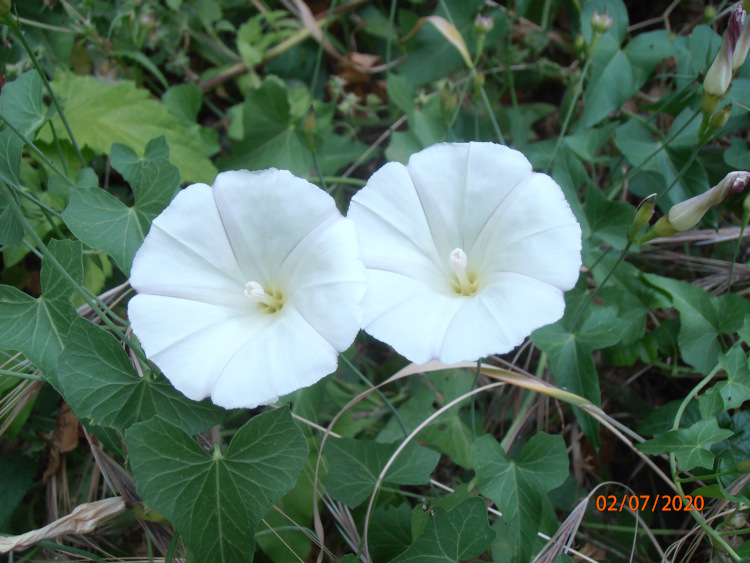
'CHAPARRAL MORNING GLORY'. White funnel-shaped 1 - 2" flowers borne in profusion from April to July. Caudex-forming woody vine with arrow-head leaves. California. Zone 8. Allow it to clamber over a bush in a sunny corner. Nick seed to germinate in 1 - 6 weeks.
CALYTRIX (ka-LEE-trix)
MYRTACEAE. Showy Australian heath-like shrubs.
—Calytrix tetragona. (100) CALX-76. Packet: $2.50
https://www.anbg.gov.au/gnp/gnp2/calytrix-tetragona.html Good photos.
https://spapps.environment.sa.gov.au/SeedsOfSA/speciesinformation.html?rid=949 Detailed seed information - takes a long time to load.
'FRINGE MYRTLE'. Abundant small white or pink starry 1/2" flowers cover the plant in bloom, followed by bronzy, starry calyces. Shrub to 3 - 10 feet, with tiny aromatic leaves. South and eastern Australia. Zone 8. Used medicinally by aborigines. Germinates best with smoke and 250ppm GA-3.
CARAGANA
—Caragana microphylla. (20) CARA-28. Packet: $2.50
Covered with 1" yellow flowers in clusters in spring. Very hardy shrub to 8 feet or so, with beautiful grey-green foliage of tiny leaflets. Siberia. Zone 3. "It is the only one that seems to resist spider mites out here in the Midwest."—Bertrand. Soak, nick hard ones, to germinate in 1 - 2 weeks warm.
CARDAMINE (kar-DA-mee-nay)
CRUCIFERAE. Annuals, biennials, and perennials with white to purple flowers. Most are dainty little plants and are easily grown. Excellent for moist shady places and heavy soil where other plants will not grow. Germination variable.
—Cardamine pratensis. (100) CARDA-64. Packet: $2.50
'CUCKOO FLOWER', 'LADY'S SMOCK', 'SPINKS'. Delicate white to pink or lilac 1/2" flowers in clusters in early spring. Hardy perennial to 12 - 20", with pinnate, cress-like leaves. North Hemisphere. Zone 3. The leaves and flowers make a piquant cress, good in salads or on sandwiches. Give seed 4 - 8 weeks prechill to germinate in 1 - 2 weeks.
CATALPA
—Catalpa X Fargesii Ecos Strain. (10) CATL-9E. Packet: $2.50
Click for photos »
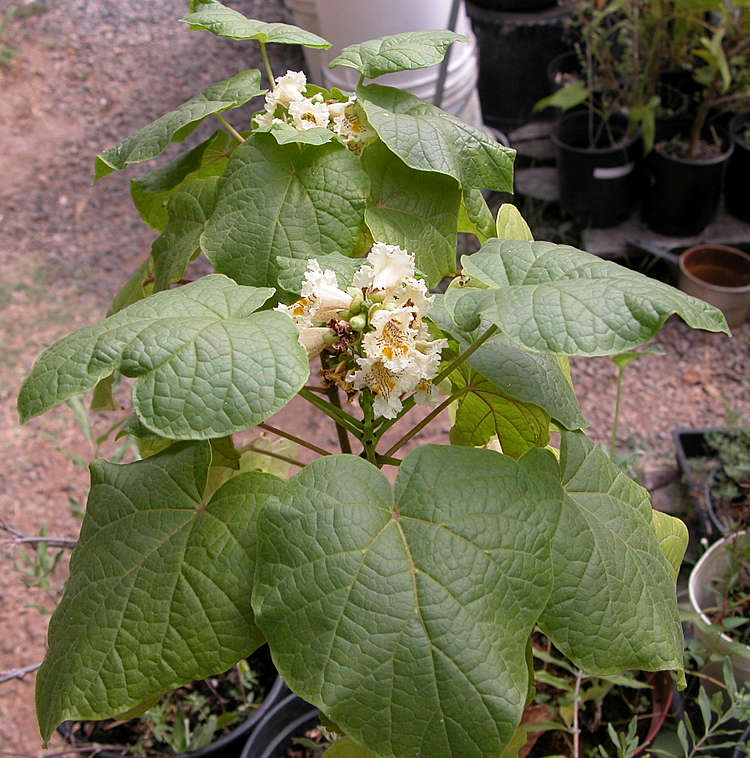
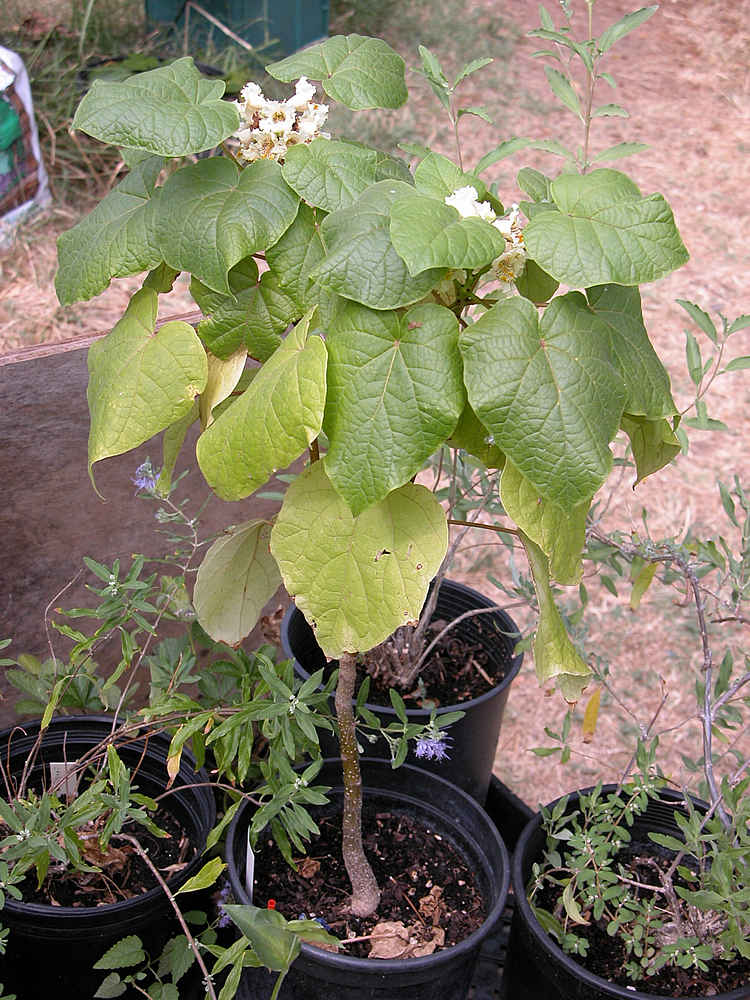
'ECOS CATALPA'. Developed by Ken Asmus of Oikos Tree Crops from a chance natural hybrid, this strain flowers when only 2 - 4 years old and 1 - 2 feet tall. Some even bloom when 6" tall! White 1 1/2" flowers with purple dots, in 6" clusters, followed by 12 - 18" bean-like pods. Small tree, the ultimate height still unknown, with heart-shaped 6" leaves. Pest and disease resistant, and hardy to at least –25°F. Germinates in 2 weeks or so.
—Catalpa speciosa. (20) CATL-22. Packet: $2.50
'WESTERN CATALPA', 'BOIS CHAVANON'. Large white, purple-spotted 2 1/2" wide bell-shaped flowers in 6" clusters in June, followed by bean-like pods to 22" long. Huge pyramidal tree to 100 feet, with foot-long heart-shaped leaves. Iowa to Texas. Zone 5. The soft wood is rot-resistant. Germinates in 1 - 4 weeks warm.
CERCIS
—Cercis chinensis. (25) CERC-2. Packet: $2.50
'CHINESE REDBUD'. Rose to rosy-purple 1/2" flowers in clusters in early spring before the leaves. Shrub or small tree to 12 - 30 feet, with heart-shaped, shiny 5" leaves. Central China. Hardy to zone 6, and does well in western high deserts. Nick and give 8 weeks cold to germinate in 2 - 4 weeks.
CERCOCARPUS (ser-ko-KAR-pus)
ROSACEAE. Small tough shrubs and trees for dry rocky soil. Attractive foliage and plume-like seeds.
—Cercocarpus montanus. (50) CERO-6. Packet: $2.50
'MOUNTAIN MAHOGANY'. Dusky pink 1/4" flowers in clusters in spring and summer, followed by attractive, twisted, plume-tailed seeds. Deciduous shrub to 4 - 6 feet, with dark green 1 - 2" leaves. Rocky Mountains. Zone 5. Very hardy and stands dry rocky places. Germinates in 2 - 4 weeks.
CHENOPODIUM
—Chenopodium capitatum. (200) CHEN-6. Packet: $2.50 EU ORGANIC
'STRAWBERRY BLITE'. Annual much like the Lamb's Quarters, to 1 1/2 feet. Triangular, toothed leaves. Europe. The heads ripen into strawberry-like edible fruits, with a flavor somewhat resembling mulberries. The leaves may be eaten like spinach. Germinates in 2 - 6 weeks warm.
—Chenopodium foliosum. (50) CHEN-9. Packet: $2.50 EU ORGANIC
'BEETBERRY'. Tart, somewhat fruity, red and black, berry-like edible fruits. Hardy annual to one foot tall. Zone 4.
CHILOPSIS (ki-LOP-sis)
BIGNONIACEAE. A single species.
—Chilopsis linearis. (50) CHIL-1. Packet: $2.50
'DESERT or FLOWERING WILLOW'. Trumpet-shaped 2" lilac flowers with 2 yellow stripes, in clusters from April to August, followed by narrow, foot-long pods. Willow-like tree to 25 feet, with narrow, foot long leaves. Southwestern U.S. deserts. Zone 8. Good arid-region ornamental. Germinates in 1 - 4 weeks.
CHRYSANTHEMUM
—Chrysanthemum Parthenium. (=Tanacetum Parthenium) (500) CHRY-40. Packet: $2.50
Click for photo »
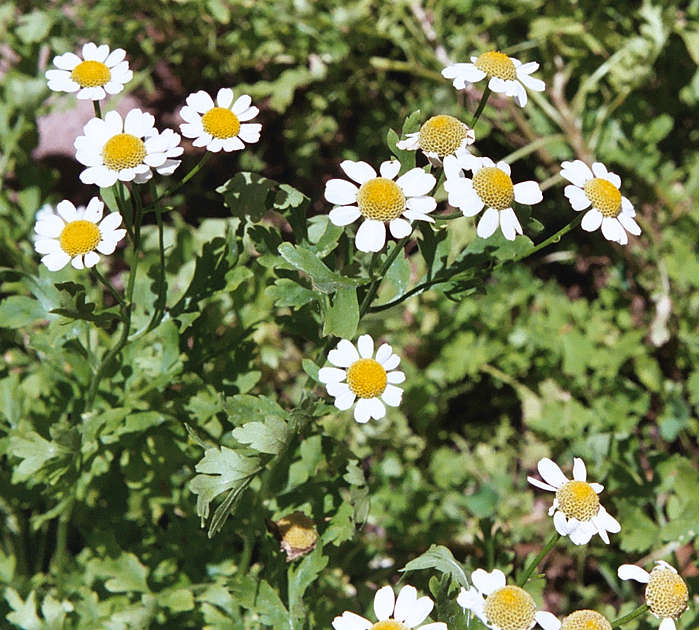
'FEVERFEW'. White 3/4" daisies with yellow centers, abundantly borne June to August. Bushy hardy perennial to 2 - 3 feet, with aromatic, deeply cut foliage. SE Europe. Zone 5. Blooms freely the first year, and is often grown as an annual. A fine old-fashioned garden plant, excellent for cut flowers. A tincture of the leaves is said to be an excellent insect repellant rubbed on the skin. Excellent remedy for migraine—I use it, it works! It made an amazing difference in my life. Germinates in 1 - 2 weeks.
CIMICIFUGA
—Cimicifuga elata. (50) CIMI-8. Packet: $2.50
Gram: $7.50 (about 500 seed)
'TALL BUGBANE'. White flowers in long branching spikes in early summer. Hardy perennial to 3 - 8 feet, with large maple-like leaves. Pacific Northwest, in moist woods. Zone 7. Prechill seed.
CIRSIUM (SIR-see-um)
COMPOSITAE. North Hemisphere biennials and perennials. Easily grown and not particular as to soil.
—Cirsium echinocephalum. (20) CIRS-20. Packet: $2.50
'PLUME THISTLE'. Purple to red flowers in spiky heads in summer. Hardy perennial to 1 foot, with attractive marbled foliage. Eastern Europe. Zone 5. Germinates in 1 - 5 weeks.
CLEMATIS
—Clematis recta. (25) CLEM-100. Packet: $2.50
Fragrant white inch-wide starry flowers in July and August. Upright hardy perennial to 5 feet, with blue-green 4" leaves. Europe. Hardy to Zone 3. Germinates in 3 - 8 weeks warm.
CONIUM (KO-nee-um)
UMBELLIFERAE. Two Eurasian species.
—Conium maculatum. (100) CONI-1. Packet: $2.50
10 grams: $7.50
100 grams: $50.00
'POISON HEMLOCK', WINTER FERN', 'SOCRATES BANE'. Finely cut ferny leaves and umbels of tiny white flowers on a biennial to 10 feet. Eurasia, widespread in N. America. Formerly used to execute criminals and philosophers in ancient Greece, including Socrates. Occasionally grown for the ornamental foliage or medicinal purposes, including modern cancer research, or in botanical collections. Germinates in 1 - 3 weeks warm. Good beneficial insect habitat, and attracts insect and seed eating birds.
COOPERIA (KOO-per-EE-a)
LILIACEAE. Several tender bulbs, sometimes classed in Zephyranthes. Good in dry areas, coming up and blooming a few days after a rain. Easily grown, seed germinates readily. Lift bulbs in the North.
—Cooperia Drummondii. (=Zephyranthes Drummondii and Z. brazoensis) (10) COOP-7. Packet: $2.50
Info and pictures
'RAIN LILY', 'FAIRY LILY'. Fragrant white 1 - 2" wide flowers open at dusk and stay open a day or two. To 9 - 12", with narrow, grass-like leaves. Blooms spring through fall after rainfall. Texas. Zone 7. Does well in gardens. Germinates in a week.
COSMOS
—Cosmos sulphureus 'Buddha's Hand'. (100) COS-3BH. Packet: 2.50 ORGANIC
1/4 Ounce: $7.50
Ounce: $20.00
Deep orange semi-double flowers on compact plants to 2 - 4 feet tall.
CRITHMUM (KRITH-mum)
UMBELLIFERAE. 'SAMPHIRE'. A single species.
—Crithmum maritimum. (100) CRIT-4. Packet: $2.50
'SAMPHIRE', 'SEA FENNEL'. Perennial to 1 - 2 feet, with fleshy divided leaves and white or yellowish flowers. Seacoasts of Europe, but thrives in sunny places. This warm, aromatic, spicy medieval herb is used in salads, with meat, as a potherb, and the leaves were salted, boiled, and covered with vinegar and spice as a pickle. Culpepper & Gerard believed that its regular consumption would prevent digestive disturbances. Its habitat on sea cliffs prompted Shakespeare to write: "Half way down hangs one that gathers Samphire; dreadful trade!"—Shakespeare, King Lear. Prechill 6 - 8 weeks to germinate in 1 - 2 weeks.
CYCLAMEN (SIK-la-men)
PRIMULACEAE. Tuberous-rooted herbs with heart-shaped leaves and beautiful flowers. Popular florist subjects. Most are grown in the greenhouse; some of the species are hardy in the North. They do best in a rich moist soil with plenty of leaf-mold and sand. Seed is variable in germination, so space them widely in flats so that the seedlings can be pricked out singly. Cover seed well. Seed sown in fall and carried over in a protected place will flower in 6 - 18 months. An important point is to keep them growing when young. Hardy species are good in shady, woodsy spots. Cyclamens may live 100 years.
—Cyclamen hederifolium. (10) CYCL-11. Packet: $2.50
'IVY-LEAF CYCLAMEN'. Soft rose-pink and white inch-long flowers on 3 - 4" stems. Large, ivy-like, heart-shaped, silver-mottled 5" leaves. S. Europe to Turkey. One of the most reliably hardy species, to Zone 5 at least. Blooms late summer and fall, after the leaves die back. Germinates irregularly, the roots forming in 3 - 16 weeks, the leaves show 1 - 2 months later.
CYMBOPOGON
—Cymbopogon flexuosus. (50) CYMP-10. Packet: $3.00
'EAST INDIAN LEMON GRASS'. Large tropical perennial grass. Strongly aromatic, used dried as a tea, source of flavoring oil, and as a substitute for Thai lemongrass. Germinates in 1 - 3 weeks.
CYNOGLOSSUM (si-no-GLOSS-um)
BORAGINACEAE, Hardy herbaceous plants grown for their forget-me-not-like flowers. Sun or part shade. Easily grown and attractive, sow direct.
—Cynoglossum creticum. (20) CYNO-6. Packet: $3.50
5 grams: $14.00
'BLUE HOUND'S TONGUE'. Flowers rosy changing to blue, with dark blue veins. Hardy, spring-blooming biennial to 1 - 2 feet, with downy leaves. Eurasia. Zone 6.
CYPELLA (SEE-pel-a or KEE-pel-a)
IRIDACEAE. Long-blooming Iris-like plants from México and South America. Best in light sandy soil. Grow like Gladiolus, lift bulbs in fall.
—Cypella coelestis. (10) CYPL-8. Packet: $3.00
Blue 3" wide flowers with yellow spots, in late summer to frost. Narrow pleated leaves. Tender perennial to 2 - 3 feet. Brazil to Argentina. Seed germinates in 1 - 6 months warm.